What Meta's Workforce Math Actually Said
Eight thousand jobs out and seven thousand roles in. The numbers reveal what the org chart hid.
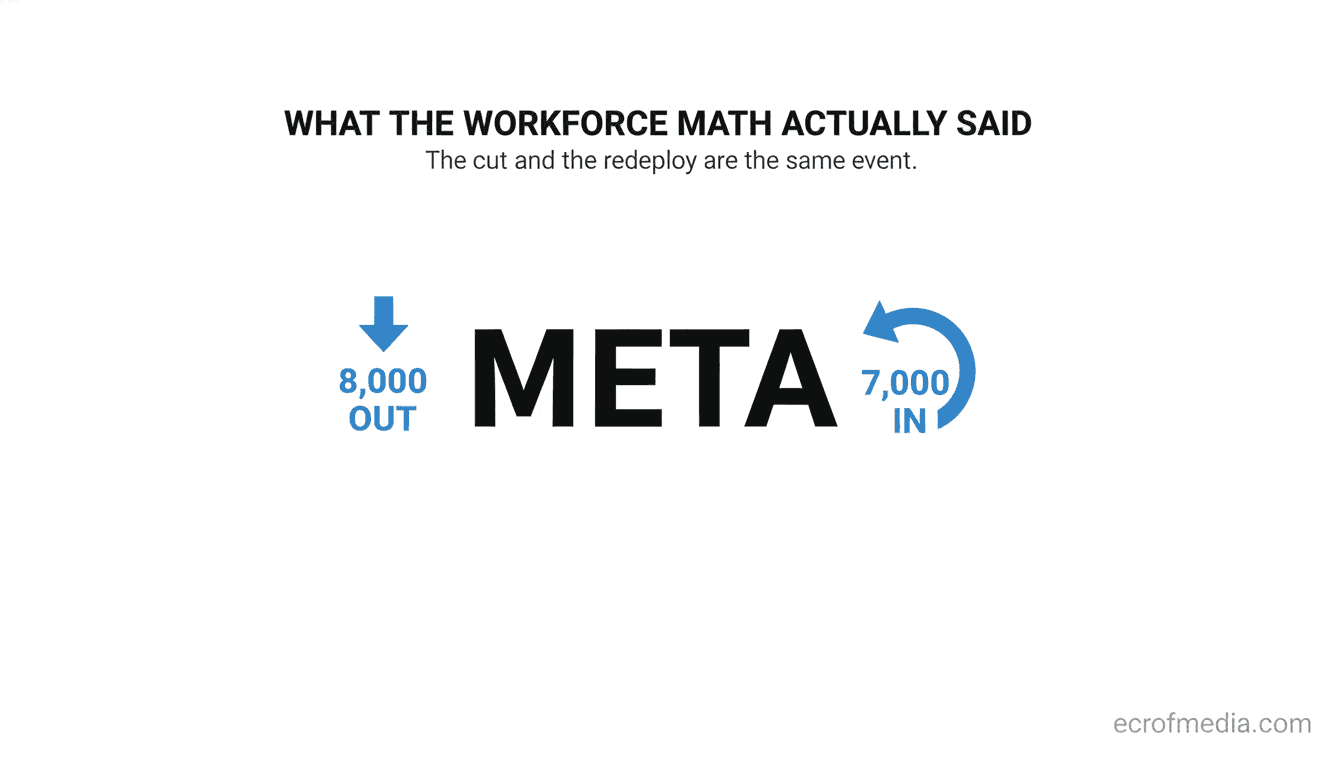
On May 21, Meta notified roughly eight thousand employees that their roles were ending. In the same week, the company told the market it planned to redeploy seven thousand people into roles tied to its next infrastructure layer. The headline was the cut. The story was the swap.
That swap is a confession most operators missed.
A net reduction of one thousand jobs does not produce a story this size. The story is the company telling the world it had been carrying seven thousand people whose work no longer matched where the work was going. The cut was not about cost. The cut was a reorganization of intelligence the company had already started to lose.
Most companies never run that kind of math in public. Meta did it because the size forced disclosure. The pattern is the same at every company under five hundred million in revenue. Nobody runs the math at all. They run the cut.
The Pattern Operators Keep Missing
When a company gets ready to contract, the question that should drive the decision is structural. Which roles still carry intelligence the business needs. Which roles were carrying intelligence into systems that no longer exist. Which roles were holding institutional memory the company cannot replace.
The question that actually drives the decision is the org chart. Who reports to whom. What the title says. Where the line sits on the management hierarchy. The cut goes through layers. The intelligence inside those layers goes with the people.
Every founder I have sat with on a Brain Map has the same pattern, just at a smaller scale. There are two to four people in the business who carry more than the system shows. There is a senior operator running a function the founder has not looked at in two years. There is an employee with three years of vendor relationships held in their head. There is a key player whose absence would expose a process nobody else can run.
When the business has to contract, the cut runs by tenure, salary band, or department. It never runs by which intelligence is structurally portable and which is locked inside one person. That is how a thirty person business loses six months of operating capacity in a single Friday.
The Cut and the Redeploy Are the Same Event
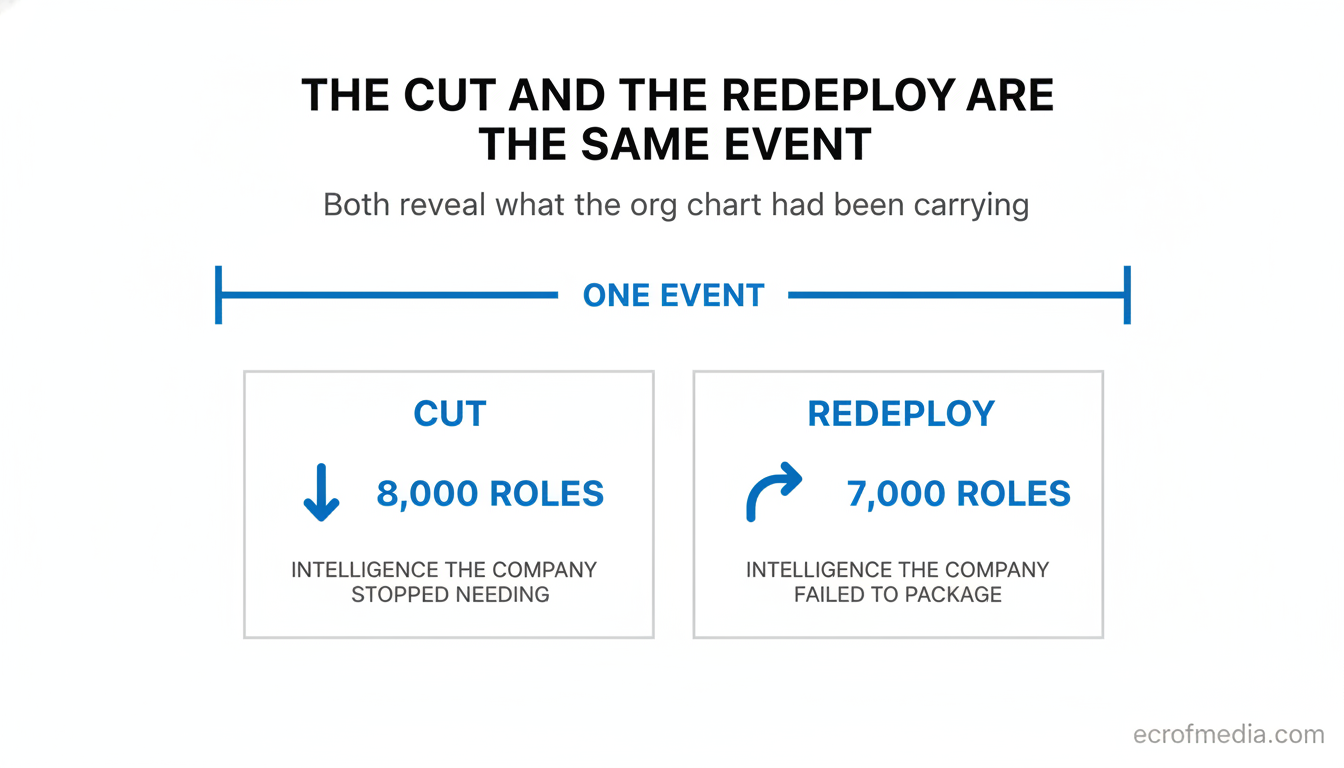
The structural read on Meta is this. Their cut and their redeploy are the same event. The cut is the company telling itself which intelligence it stopped needing. The redeploy is the company admitting which intelligence it failed to package in time.
Seven thousand people were already inside the company. Meta already had their context, their decisions, their reads, their relationships. Reassigning them does not transfer that intelligence into the new layer of the business. It transfers the people. The intelligence stays inside their heads, walks with them into the new role, and rebuilds itself from scratch in the new context.
That is what a redeploy costs that a hire does not. The hire arrives at zero. The redeploy arrives with the wrong context still loaded. The company pays both the cost of moving the person and the cost of unloading what they used to know.
The companies that will survive the next ten years are the ones whose intelligence is portable across reassignments. The companies that will struggle are the ones whose intelligence lives inside roles. When the role changes, the intelligence is lost twice. Once from the old function that needed it. Once from the new function that cannot use it in its current shape.
A company that has packaged its intelligence reorganizes by reassigning packaged context. A company that has not packaged its intelligence reorganizes by reassigning people and hoping the context survives the move.
This is the Margin Design read. Margin is not created by cutting cost. Margin is created by reducing the cost of every future decision, including the decision to reorganize.
What This Means for a Founder Led Business
The next workforce action you take, whether it is a hire, a fire, a reassignment, or a contraction, is going to expose how much of your business runs through individuals versus how much runs through structured infrastructure. The exposure happens whether you planned for it or not.
The move is to run the audit before the action forces you to.
Start with the two to four people in your business who carry the most. Not by title. By failure mode. If they were unavailable for thirty days, what stops moving. That answer names the intelligence you are most exposed on.
For each person on that list, write down what they actually know that the business depends on. Not what their job description says. What they decide, who they call, what they read first when something breaks, how they price the edge cases, where their judgment lands when the inputs are ambiguous.
Then take the most exposed item on that list and package it. One decision rule. One vendor map. One pricing logic. One client routing tree. Put it somewhere the business can read it back without that person being in the room. That single move reduces your reorg risk on the next workforce event.
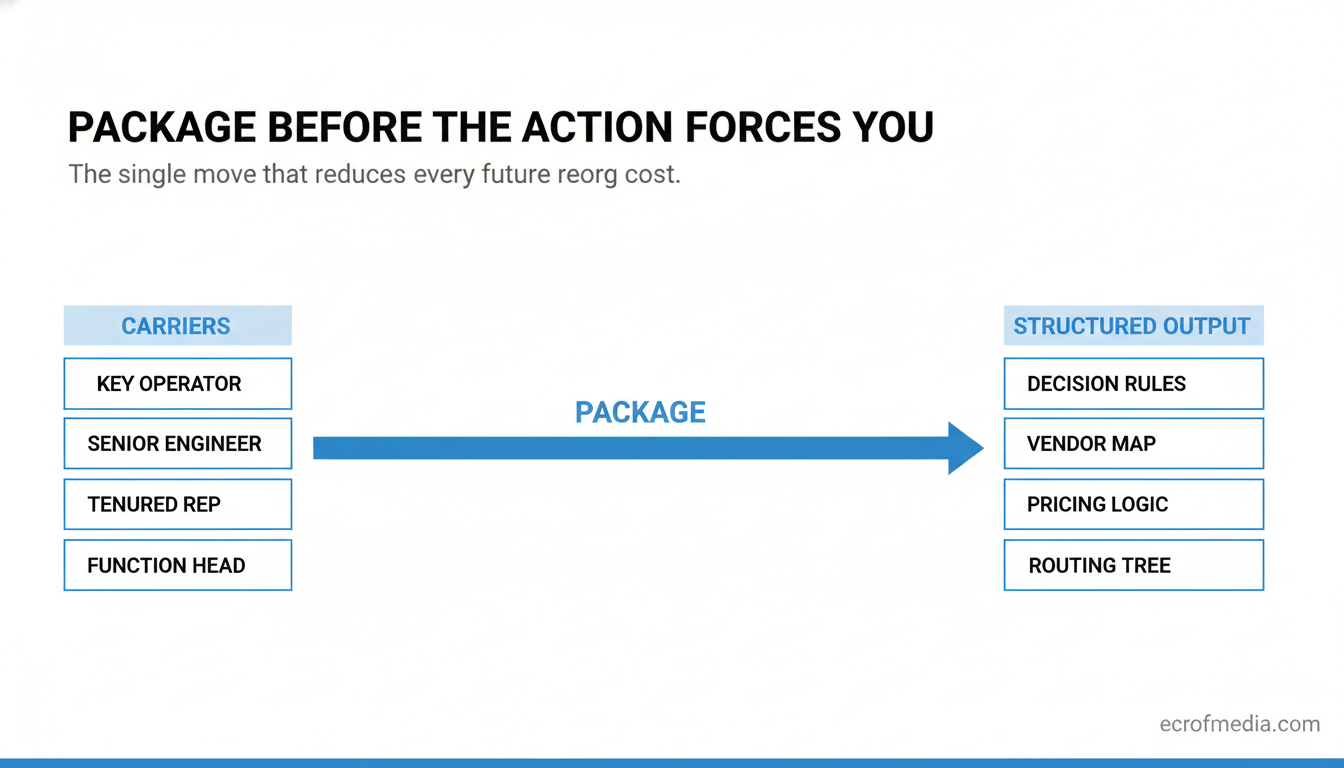
The reorg is coming, regardless of what your headcount plan says. The recession does not care about your roadmap. The product shift does not care about your tenure tracks. The next acquisition you do, the next product line you build, the next platform shift in your industry, all of them will force a reshape.
The question is whether you reshape by moving packaged intelligence into new positions, or by moving people and crossing your fingers.
The Work That Pays Before the Action Forces You
Most founder led businesses sit closer to the second option than they want to admit. The work is not learning to plan workforce moves better. The work is packaging what already lives in your operators so the next move costs less.
If you want the structural read on where your business is most exposed, the Brain Map is the entry point. Forty five minutes. We walk your business through the same lens we just walked Meta through. You see what you are carrying, where it is concentrated, and what one move would change the most.
You can book it from the resources page on the Hub.
Where the numbers come from
See this in your own business.
We run a live workshop where we walk through exactly where your business intelligence is accessible and where it is still trapped. You will leave with a clear picture of what needs to be packaged first.
Join the Live Workshop