Your Customers Stopped Scrolling. They Started Asking.
How a small business gets found like the chain, then wires the parts together so the activity runs the business on its own.
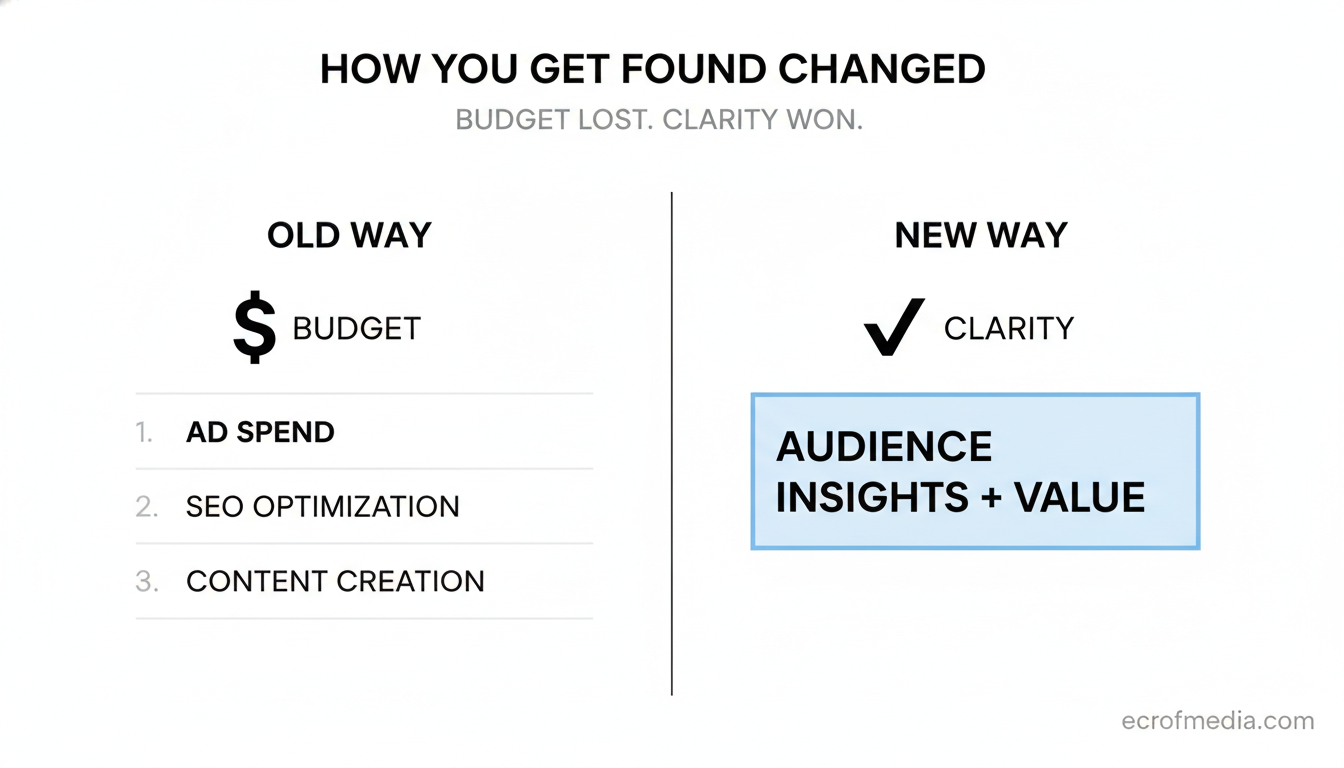
For most of the last twenty years, getting found was a budget contest. If someone in your town needed an electrician, a dentist, a roofer, they opened a search and scrolled a list. The businesses at the top were usually the ones who paid to be there. The corner shop with twelve years of happy customers sat on page two, invisible, because it never had the budget to buy its way up. Being good was not enough. You had to be good and rich, and most small businesses were only the first one.
That contest is quietly ending. Not because the small business got a bigger budget. Because the way people find you changed.
More and more, a customer does not scroll a list at all. They ask. They open an assistant and type the way they actually talk. Who is the best company near me to fix a heat pump that freezes up in winter. Where can I get a same day crown without driving an hour. And something on the other side reads the whole web, picks a handful of businesses, and hands back a short answer. No page two. Just a recommendation, the way a neighbor would give one.
Here is the part that should make every small business owner sit up. That recommendation is not for sale. The system handing it out does not care who paid for an ad. It cares who is clear, specific, and proven. For the first time in a generation, the thing that decides whether you get found is not the size of your budget. It is the quality of what you have already built.
What the recommendation is actually reading
When that answer gets assembled, something is reading your business the way a careful new customer would, only faster and across every source at once. It is looking for a few simple things.
It wants to know exactly what you do and exactly where you do it. Not serving the metro area. Replaces frozen capacitors on AC units across Round Rock, Mueller, and South Congress. It wants proof, in the words of real customers. A review that says they fixed the main line at our place near the old high school is worth more than fifty that say great service. It wants consistency. A business that says the same true things about itself everywhere it appears reads as solid. One that contradicts itself across a dozen listings reads as a coin flip.
None of that requires money. It requires clarity. And clarity has always been the one thing the small business had more of than the chain. You know your customers by name. You know which street floods. You know the exact question every caller asks before they book. The chain has a budget. You have the truth. Until now there was no way to turn that truth into being found. Now there is.
The chain has a budget. You have the truth. For the first time, the truth is what gets you found.
The gap you could never afford just closed
This is the move, and it is the whole point of what we do. There was always a gap between the small business and the big one. The big one could afford the marketing team, the agency, the systems that kept it visible everywhere at once. The small one could not, so it stayed local, stayed quiet, and watched the chain take customers it could have served better.
The gap did not close because the small business got rich. It closed because the work the agency used to do, putting your real answers in front of the people asking for them, can now be done with tools that cost less than a phone bill. The capability that used to live behind a budget now lives behind a decision. You decide to be clear. You decide to be specific. You write down what you actually know, and you put it where the question gets asked.
A single chair dental practice can now answer every after hours question a nervous patient types at midnight. A two person law office can show up for the exact local question a client asks instead of losing them to a firm with a marketing department. The size of the team stopped being the thing that decides who gets found. The clarity of the business started being that thing.
One call is never just one call
Now here is where we go further than the marketing advice you will read everywhere else. Getting found is the start, not the finish. The day those calls jump a quarter, something happens that most owners feel as a problem instead of a win. The phone rings more. The schedule tightens. A truck that used to have slack now runs late. The owner ends the week exhausted, wondering why more business felt worse.
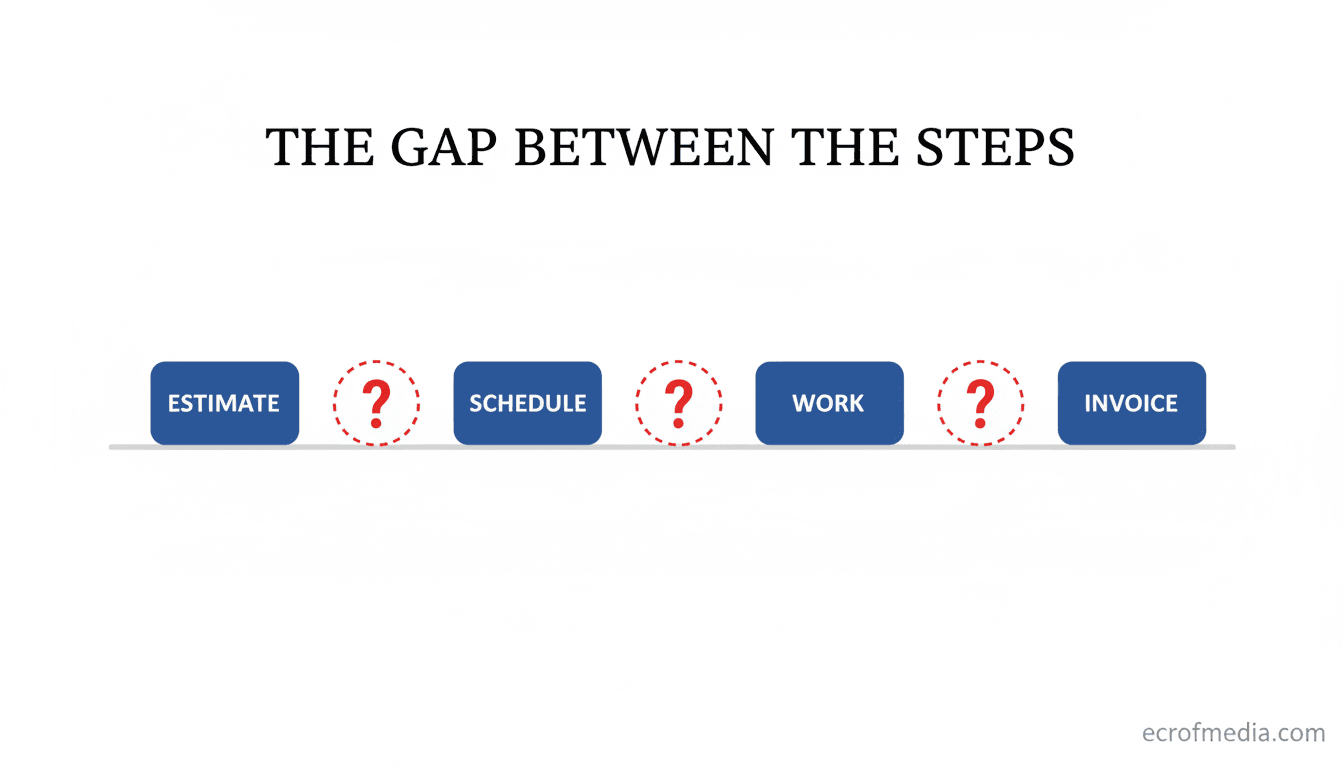
That happens because the call lives in one box. Sales went up, and nothing else was told. But a call is never just a call. It is a job that has to be scheduled. It is a route a truck has to run. It is cash that arrives on a certain day, before or after payroll. It is, eventually, the moment you need another technician, and the only question is whether you saw it coming or got buried first.
Every one of those is a different part of the business. Sales. Operations. Finance. Hiring. In most small businesses they do not talk to each other. The owner is the only wire connecting them, carrying each signal across in their own head, by hand, at the end of a long day. That is why growth so often feels like drowning. The parts are not connected. The owner is the connection.
What it looks like when the parts are wired together
Picture the same week, with the parts connected.
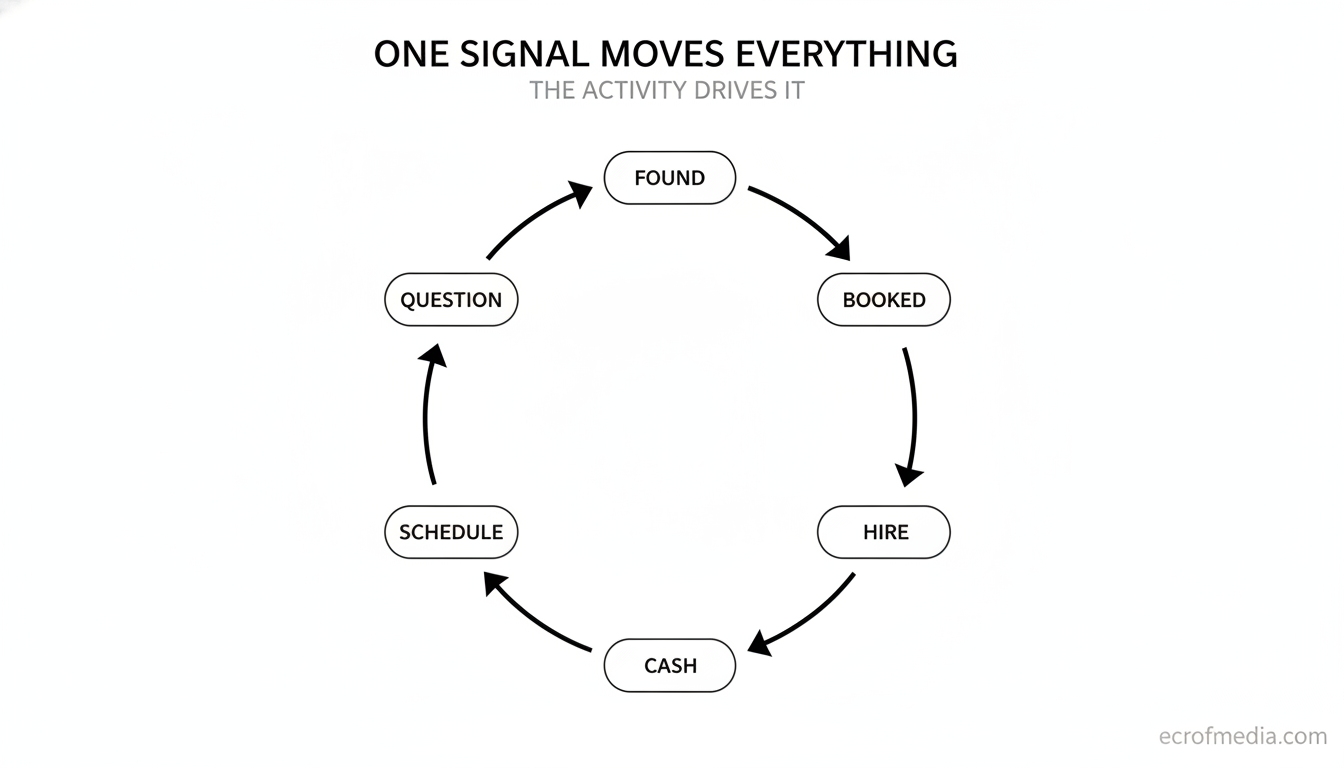
The questions customers ask become the content that gets you found. Being found books more jobs. More jobs fill the schedule, and the schedule shows you, today, that next Thursday is overbooked before a single customer is disappointed. The booked work tells finance what is coming in and when, so payroll week is a plan instead of a prayer. And when the booked hours cross a line you set, the business raises its hand and says it is time to hire, while you still have the calm to hire well.
Nobody pushed those buttons. The owner did not move the signal from sales to operations to finance to hiring. The activity did.
The business that moves on its own
This is the spin we put on everything, and it is the whole point of the work. Closing the gap gets you found. Wiring the parts together is what makes the business move. The goal was never a busier owner with better tools. It was a business where the activity itself does the driving, so the owner stops being the wire and starts being the one who decides where it all goes.
You build it once. You write down what the business knows, you connect the parts so a signal in one moves the next, and then you let the activity run it. The customer asks. The answer publishes. The job books. The schedule fills. The cash forecasts. The hire surfaces. Around again. The owner is not hitting every button. The owner is watching a business that finally moves on its own, and stepping in only where judgment is actually needed.
The next level: a business that acts, not just moves
Moving on its own is the first level. The signal flows, and the business surfaces what needs deciding before it becomes a fire. The next level is autonomy, where the routine decisions stop waiting for you at all. The overbooked Thursday does not just light up. It quietly reshuffles the two jobs that can flex, sends the affected customers a new window to confirm, and escalates only the one appointment that genuinely needs a human to weigh in. The low part on the truck does not just flag. It reorders. The five star review does not just get noticed. It gets a reply written in your voice, ready for a glance and a nod.
For a service business this is where the efficiency compounds. Every routine action that used to need a person to trigger it now happens on its own, inside the rules you set. You decide what it is allowed to do alone, what it has to ask about first, and where the hard line sits. Then it runs inside those lines, and your attention stops being spread across a hundred small tasks and lands on the few that actually need your judgment. The business gets faster, not because you move faster, but because most of it no longer waits on you to move at all.
Less of the business depends on you pressing a button. More of it runs itself. The only things that reach your desk are the ones that were always going to need you.
That is the Autonomy Layer, and it is the direction everything points. You can build toward it yourself, one connected piece at a time, or you can have it run for you as a service while you keep doing the work only you can do. Either way the line moves the same way. The business carries more of itself, and you carry less of it by hand.
That is what Built to Move means in practice. Not a faster way to do the work by hand. A business that knows what it knows, connects what it knows, and runs on its own activity. The corner shop was never short on quality. It was short on motion. That part is finally fixable, and it starts with the simplest thing in the world. A customer, asking.
Where this comes from
- U.S. Chamber of Commerce: 2026 report on small firms competing above their size
- Forbes: how small businesses are actually putting these tools to work
- Coastal Growth: a Jacksonville home services operator grew calls 25 percent in a month
- MarketingAgent: how local discovery now reads clarity and proof signals
See this in your own business.
We run a live workshop where we walk through exactly where your business intelligence is accessible and where it is still trapped. You will leave with a clear picture of what needs to be packaged first.
Join the Live Workshop