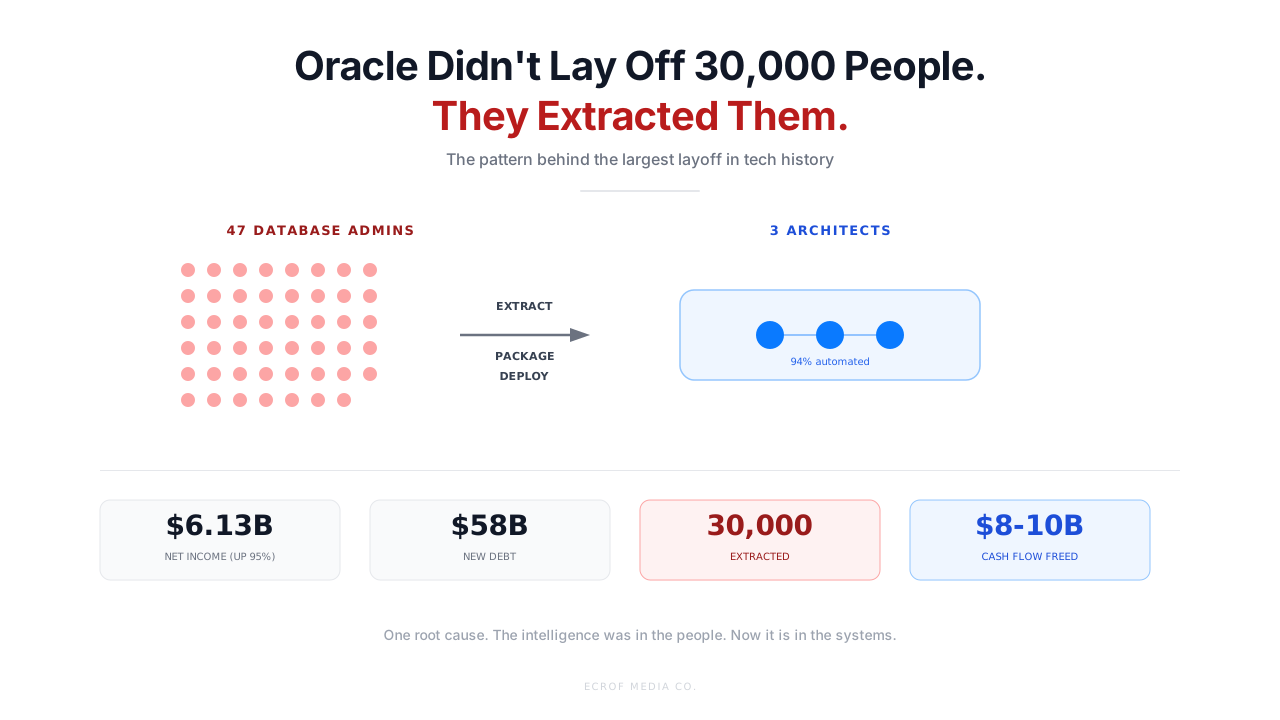
Oracle Didn't Lay Off 30,000 People. They Extracted Them.
Oracle spent eight months extracting what 30,000 employees knew, packaging it into systems, and verifying those systems could operate without them. Then they sent a 6 AM email. Here is what that pattern means for your business.
47 database administrators in Austin, Texas.
That was the team Oracle had managing a core piece of their cloud infrastructure. Experienced people. Senior engineers. Doing the work, carrying the knowledge, keeping things running.
Eight months later, three architects oversee the same operation. The other 44 are gone. Not because they failed. Because Oracle spent those eight months extracting what they knew, packaging it into systems, and verifying those systems could operate without them.
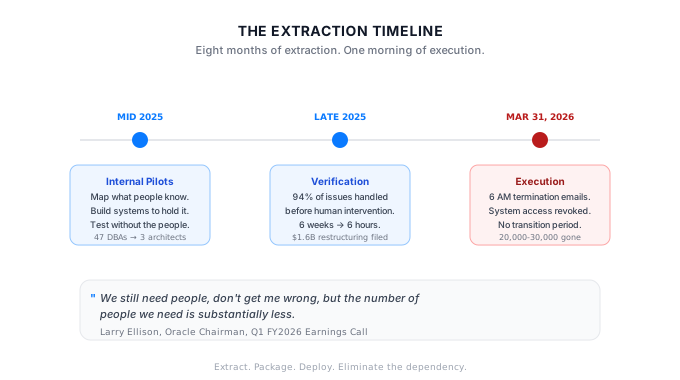
Then, on March 31, 2026, Oracle sent termination emails at 6 AM. No manager call. No HR conversation. No transition period. Slack access revoked. Zoom killed. VPN shut off. Badge deactivated. All within minutes.
Between 20,000 and 30,000 people received that email. Roughly 18% of Oracle's entire workforce. The largest layoff in the company's 48 year history.
Here is the part that should get your attention: Oracle was not in trouble.
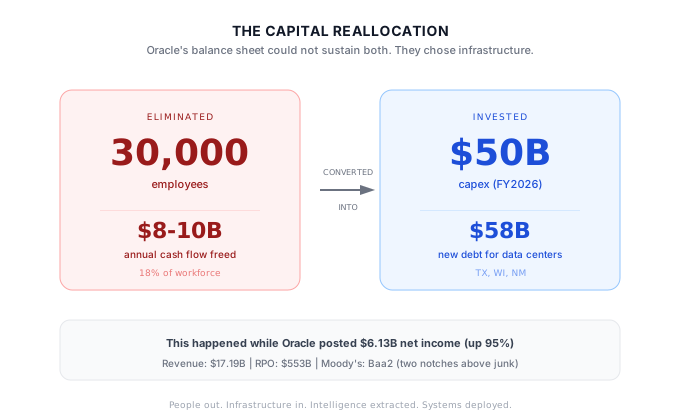
They had just posted a 95% jump in net income to $6.13 billion. Revenue hit $17.19 billion for the quarter, up 18%. Their remaining performance obligations sat at $553 billion. This was not a company cutting costs to survive. This was a company reallocating capital to build something else.
The Debt That Forced the Decision
Oracle took on $58 billion in new debt in roughly two months. The money went to data center infrastructure across Texas, Wisconsin, and New Mexico. Total debt now exceeds $108 billion. Moody's rates them Baa2. Two notches above junk.
Their capital expenditure target for the fiscal year: $50 billion. Up 136% from the year before.
The balance sheet could not sustain both the infrastructure buildout and the people. So Oracle chose the infrastructure.
The layoffs are projected to free up $8 to $10 billion in annual cash flow. TD Cowen, the investment bank that first flagged the cuts in January, put it bluntly:
Every eliminated position is effectively being converted into server capacity.
That is the math. People out. Infrastructure in. Intelligence extracted. Systems deployed.
The Extraction Pattern
This is the part most people are missing.
Oracle did not just fire 30,000 people. They ran extraction programs for eight months before the emails went out.
Internal pilots replaced operational roles with structured systems across database administration, implementation workflows, and engineering support. The 47 person team in Austin was one documented example. Internal metrics reportedly showed their systems handling 94% of issues before a person needed to intervene. Implementation workflows that used to take six weeks compressed to six hours.
Larry Ellison, Oracle's chairman, said it on an earnings call months earlier:
We still need people, don't get me wrong, but the number of people we need is substantially less.
Co-CEO Mike Sicilia echoed it: smaller engineering teams delivering more complete solutions, more quickly.
They were telling you. The extraction was already underway.
Oracle identified the intelligence those 30,000 people carried. They packaged it into infrastructure. They verified the infrastructure could operate. Then they had the people walk out the door.
That is not a layoff.
That is an extraction and repackaging event at enterprise scale.
The Overfunctioning Trap at $108 Billion
Here is where the pattern gets structural.
Oracle looked at tens of thousands of employees who were doing their jobs. Many of them profitably. Many of them senior. Architects, engineers, program managers, operations leaders, customer success advisors. People with 5, 10, 20 years of institutional knowledge.
And Oracle identified them as a cost the business could no longer carry. Not because the work was unnecessary. Because the dependency on those individuals to execute the work was more expensive than packaging the intelligence they carried into systems that could run without them.
Those 30,000 people were carriers. They held operational knowledge across every layer of the business. Oracle recognized the intelligence risk, extracted what the carriers knew, packaged it, and eliminated the human dependency.
A senior manager at Oracle posted on LinkedIn after the cuts:
The individuals affected were not let go because of anything they did or didn't do.
That is the overfunctioning trap at enterprise scale. The work was valuable. The people were capable. The dependency was the cost.
What This Means If You Run a Service Business
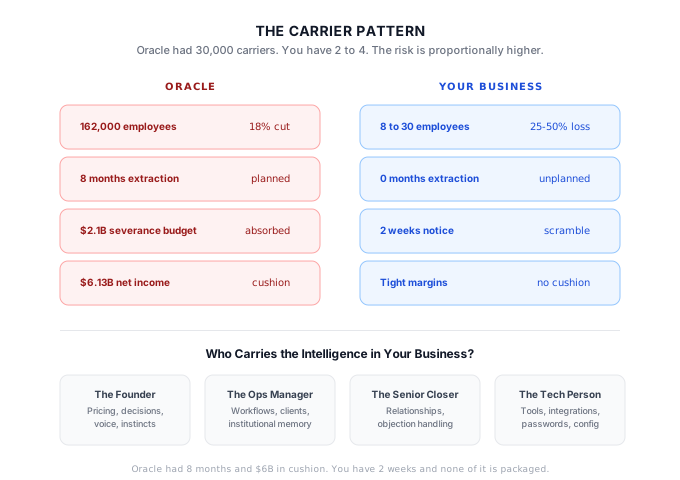
Oracle is a $17 billion per quarter enterprise. You are probably running a $2M to $25M service business. The numbers are different. The pattern is identical.
The same carriers exist in your business.
In most founder-led service businesses, two to four people carry 80% of the operational intelligence the business needs to move. The founder carries the pricing logic, the decision framework, the brand voice. The ops manager carries client preferences, workflow knowledge, and institutional memory. The senior closer carries relationship context and objection handling. The tech person carries tool configuration and integration logic.
None of it is documented.
None of it is packaged.
All of it is at risk.
The same balance sheet pressure exists.
Oracle's balance sheet could not sustain both the people and the infrastructure investment. Your version of that pressure looks different. It is not $58 billion in debt. It is the cost of carrying key people whose knowledge lives only in their heads while simultaneously needing to invest in systems, tools, and operational infrastructure that can function without them. Every month you delay packaging that intelligence, the gap between what your business needs and what your business can access without those specific people gets wider.
The same extraction choice exists. You are just not making it yet.
Oracle spent eight months extracting before cutting. Most service businesses never extract at all. When the ops manager gives two weeks notice, the knowledge walks out the door. When the founder takes a vacation, decisions stop. When the senior closer leaves, the close rate drops and nobody knows why.
Oracle quantified the cost of unextracted intelligence at $8 to $10 billion a year. Your number is smaller. Proportionally, it might be higher.
But there is a critical difference.
Oracle can absorb a bad bet. A $5M service business cannot. Oracle had 162,000 people. If you have 15, losing one key player is not an 18% reduction in headcount. It is a 25 to 50% loss in operational knowledge.
Oracle's Moody's rating dropped to two notches above junk. Your version of that is a key client leaving because your ops manager quit and nobody knows the handoff process.
The Downstream Impact You Are Already Feeling
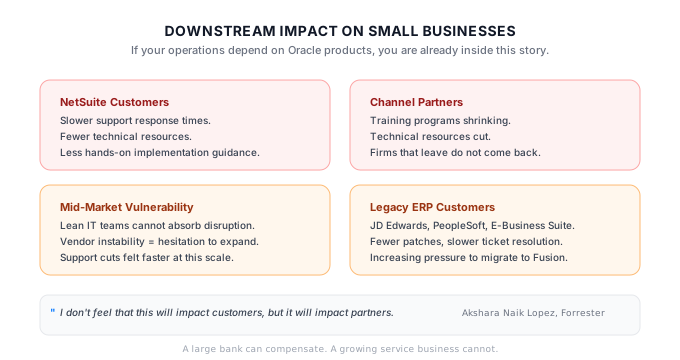
If your business runs on Oracle products, you are already inside this story.
NetSuite customers across the small and mid market are seeing slower support response times, fewer technical resources, and less hands on guidance. Oracle gutted the customer success, support, and partner enablement teams that those customers relied on.
Forrester analyst Akshara Naik Lopez said it plainly: she does not feel it will impact customers, but it will impact partners. She is wrong on the first part. Mid market companies that depend on vendor support feel the cuts faster precisely because they do not have sprawling internal teams to absorb the disruption.
Channel partners are losing access to training programs and technical resources. The firms that remain consolidate. The ones that leave do not come back.
If your operations depend on a platform whose vendor just eliminated 18% of its workforce while posting record profits, you need to ask what happens to your support pipeline. Not someday. Now.
The Billion Dollar Question
The question is not whether intelligence extraction is happening. Oracle just proved it is, at the largest scale in tech history.
The question is whether you are the one doing the extracting, or whether you are the one being extracted from.
For founder-led businesses, the pattern is identical to Oracle's, just at a different scale. The intelligence your business runs on is trapped in two to four people. The longer it stays trapped, the higher the cost. Oracle put a number on that cost: $8 to $10 billion a year. Then they acted on it in a single morning with a 6 AM email.
You do not need $58 billion in debt to start.
You do not need to fire anyone.
You need to know what is packaged and what is trapped. Who carries what. Where the intelligence risk lives. What it would cost you if one of those carriers walked out tomorrow.
That is what a Brain Map does. It maps the intelligence across your business in 45 minutes. What is structured, what is trapped, who carries it, and what happens if they leave.
Oracle solved this with billions of dollars and zero notice.
You can solve it with a diagnostic and a structured extraction process.
The pattern is the same. The scale is different. The urgency is not.
Sources and References
- Oracle Q3 FY2026 Earnings: 95% Net Income Jump to $6.13B
- Oracle March 2026 Layoffs: Up to 30,000 Employees (CIO.com)
- TD Cowen Research: $8B to $10B Cash Flow Freed by Cuts
- Oracle $2.1B Restructuring Plan (SEC 10-Q Filing)
- Oracle Takes On $58B in New Debt for Data Centers
- Forrester: Impact on Oracle Partners and Mid-Market Customers
- Oracle Internal Pilots: 47 DBAs Replaced by 3 Architects (InvestingLive)
- Stargate Initiative: $500B Joint Infrastructure Project
THE BRAIN MAP
A live 45 minute diagnostic that maps what is packaged in your business and what is still trapped inside you and your key players, across all seven layers of how you operate. See what it surfaces.
See where the intelligence risk sits.
The Brain Map is a live 45 minute diagnostic that maps what is packaged in your business and what is still trapped inside your key players.
Get Your Brain Map