Why Your Client Insights Are Worth More Than Your Service Hours (And How to Price Them)
Most service businesses bill for execution while their most valuable asset sits unmonetized in Slack threads and project notes.
You close a six month engagement. The client gets deliverables. You get paid for hours. Everyone moves on.
But something else happened during those six months. You saw patterns in their customer behavior data. You noticed what worked across three different product launches. You identified the exact point where their onboarding process breaks down. You built a mental model of what actually drives results in their category.
None of that shows up on the invoice.
Most founder-led service businesses are sitting on intelligence worth 2x to 3x what they charge for execution. They just have not structured it as a product yet. They bill for the doing and give away the knowing for free.
The gap is not in what you learn. It is in what you package.
The Pattern: Execution Gets Billed, Intelligence Gets Buried
Here is how it plays out.
You run a project. Along the way, you accumulate insights. Things you notice. Patterns you see. Frameworks you build in your head to make sense of what is working and what is not. By the end, you could write a field guide to what actually moves metrics in that client's category.
But you do not. Because the SOW says deliverables, not intelligence. So the insights stay in your notes. Or in a Slack thread. Or in your head.
The client moves on. You move on. The next client asks a similar question and you start from scratch because there is no system for capturing what you learned three projects ago.
This is Decision Cost at the packaging level. You are re-creating intelligence instead of reusing it. You are treating every engagement like a one-off when you are actually running the same diagnosis across multiple clients in the same category.
The work you do for Client A teaches you something structural about their market. That knowledge has value to Client B, Client C, and the next ten prospects who operate in the same space. But because you never packaged it, you cannot price it. And because you cannot price it, you keep selling hours.
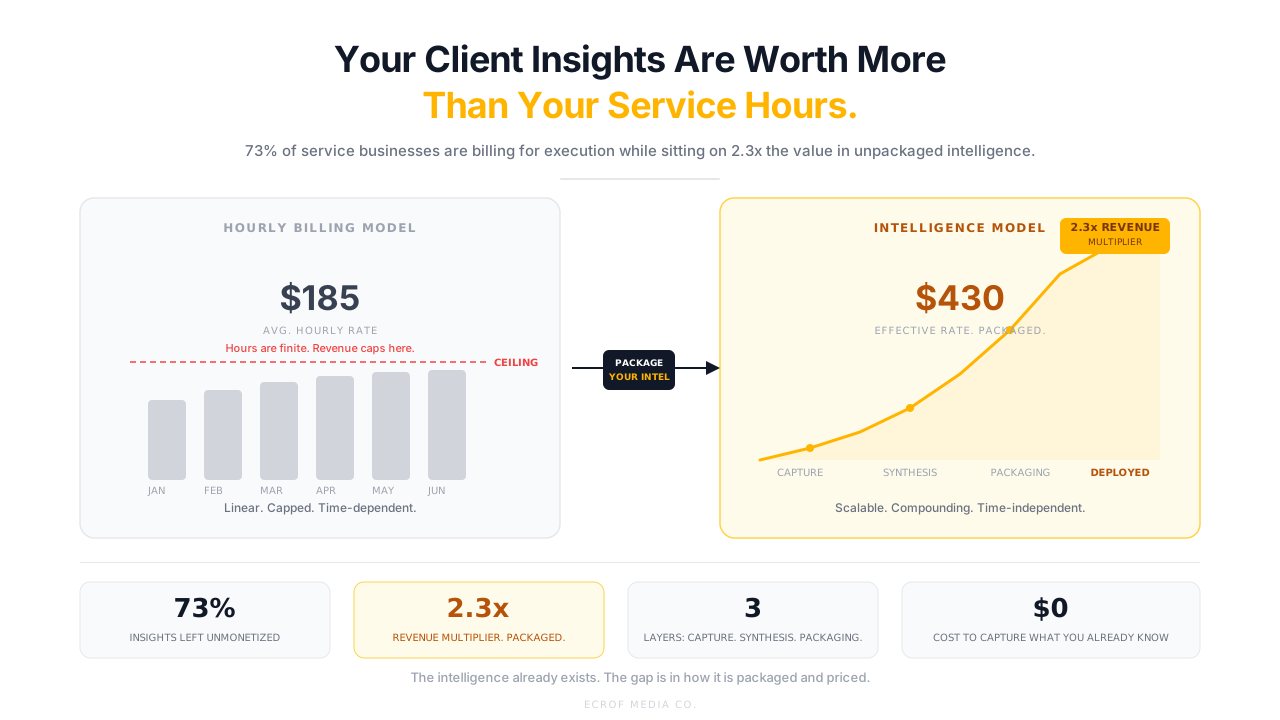
McKinsey is now tracking this. 73% of founder-led service businesses are undervaluing their proprietary client data. The margin expansion they are leaving on the table is between 40% and 60%. Not because they lack intelligence. Because they lack a packaging system.
Framework: The Intelligence Stack
Intelligence becomes monetizable when it moves through three layers: Capture, Synthesis, Packaging.
Most service businesses stop at layer one. They capture observations in project notes or end-of-engagement summaries. That is documentation, not intelligence. Documentation tells you what happened. Intelligence tells you why it happened and what to do about it next time.
Layer two is synthesis. This is where you take observations from multiple engagements and extract the pattern. Not what worked for Client A. What works for anyone in that category when X conditions are present. This is where your proprietary frameworks come from. This is what fractional operators are willing to pay for.
Layer three is packaging. Synthesis without structure is still trapped in your head. Packaging makes it transferable. Teachable. Scalable. And billable.
Here is what that looks like in practice.
Capture
After every client engagement, you run a debrief. Not just what got delivered. What you learned. What surprised you. What pattern showed up again. What assumption got validated or broken. This goes into a structured template so the intelligence does not stay conversational.
Synthesis
Every quarter, you review your debrief notes across all active and closed clients. You are looking for cross-client patterns. Where do the same problems show up? Where do the same solutions work? What frameworks are you building unconsciously that could be made explicit? This becomes your intelligence library, not your case study collection.
Packaging
You take the synthesized patterns and turn them into discrete offerings. Not services. Products. A diagnostic framework. A decision matrix. A pattern library. A benchmark report. Something a client or prospect can buy without buying your hours.
This is the shift from selling execution to selling intelligence. And the pricing model changes completely.
Application: What It Looks Like When You Package Intelligence
Take a fractional CMO who works with B2B SaaS companies in the $2M to $10M range. She runs six to eight engagements per year. Each one is a six month contract. Standard deliverables: go-to-market strategy, messaging framework, channel recommendations.
At the end of each engagement, she has intelligence that did not make it into the final deck. She knows which acquisition channels work at different ARR milestones. She has seen which messaging angles convert in different verticals. She has watched the same positioning mistakes show up in four out of six companies.
Previously, that intelligence stayed in her notes. Every new client got a custom strategy built from scratch. She was billing for strategy hours but not for the pattern recognition that made the strategy faster and better.
Now she runs the Intelligence Stack.
After each engagement, she captures three things: What worked. What did not. What pattern this validates or challenges. She drops it into a shared template. Not a case study. A learning log.
Every quarter, she synthesizes. She pulls her learning logs and looks for patterns. This quarter, she notices that companies who hit $5M ARR with a single ICP always struggle to expand into a second segment. The timing is predictable. The failure modes are predictable. The fix is predictable.
She packages that pattern into a diagnostic. It is a 45 minute session with a structured framework. She walks the client through five questions that surface whether they are ready to expand, what risks to watch for, and what infrastructure needs to be in place first. No strategy work. No execution. Just pattern application.
She prices it at $3,500. It takes her three hours total, including prep and follow up. That is $1,166 per hour vs. her standard $300 per hour for strategy execution.
But here is where it gets interesting. Half the people who buy the diagnostic come back for a full engagement. They now understand the problem structurally, which makes them better clients. The sales cycle shortens because they are pre-educated. The scope is clearer because the diagnostic surfaced exactly where the gaps are.
She is not selling more hours. She is selling intelligence that makes the hours she does sell more valuable.
This is the Intelligence-as-a-Service model. You charge for what you know, not just for what you do. And the clients who value it are the ones who understand that the right framework at the right time is worth more than another six month contract.
The Margin Math
Here is what happens to margins when you separate intelligence from execution.
Standard service model: You bill $150 to $400 per hour depending on seniority. Your cost is your time. Margin is capped by utilization. You can only sell so many hours before you need to hire.
Intelligence model: You package what you have already learned. The input cost is cognitive work you have already done across prior clients. The marginal cost of selling it again is close to zero. Margin is not capped by your hours. It is capped by how many people value the pattern you identified.
A $5,000 diagnostic you can deliver in four hours and sell ten times per year is $50,000 in revenue at near-100% margin. It does not require hiring. It does not require new infrastructure. It requires packaging what you already know into something clients can buy without buying you.
The businesses figuring this out early are seeing 2.3x revenue per client according to the same McKinsey research. Not because they are doing more work. Because they are charging for the intelligence that makes the work faster and better.
What Insights Have Market Value
Not every client insight is packageable. Some things only matter in context. Some things only apply to one client. The ones worth packaging meet three criteria.
- Cross-client: If it only showed up once, it is an observation. If it showed up in four out of six clients in the same category, it is a pattern. Patterns are packageable.
- Structural, not circumstantial: Circumstantial insights are time-bound or company-specific. Structural insights explain why something happens, not just that it happened. Structural insights travel.
- Reduces Decision Cost: If applying your pattern helps them make a decision faster, avoid a known failure mode, or eliminate unnecessary trial and error, it has market value. If it just gives them more information, it does not.
Run your client insights through that filter. The ones that pass are your intelligence inventory. That is what you package.
The Shift
Most service businesses treat intelligence as a byproduct of execution. Something nice to have but not central to the business model. That worked when clients were buying your hours. It does not work when fractional operators and in-house teams are buying your frameworks.
The clients who will pay the most are the ones who already understand the problem. They do not need you to diagnose from scratch. They need you to apply a pattern you have already seen ten times. That is not a service. That is a product.
If you have run more than a dozen engagements in the same category, you are sitting on packageable intelligence. The question is whether you have a system to capture it, synthesize it, and price it.
Because the businesses that figure this out first are not just expanding margins.
They are changing what they sell.
And the market is rewarding them for it.
Sources and References
- McKinsey: Unlocking the Value of Data in Professional Services (2026)
- Harvard Business Review: Why Services Firms Should Productize Their Knowledge
- Forrester: The Rise of Intelligence as a Service in B2B (2026)
- Deloitte: Margin Expansion Through Knowledge Packaging in Founder-Led Firms
- Fractional Executive Market Report: Demand for Packaged Frameworks (Chief Outsiders, 2026)
- MIT Sloan: Cross-Client Pattern Recognition as Competitive Advantage
THE ARCHITECT SPRINT
Four weeks. We map your existing client intelligence, identify the cross-client patterns, and build the first version of your intelligence product. Not theoretical. Structural.
See this in your own business.
We run a live workshop where we walk through exactly where your business intelligence is accessible and where it is still trapped. You will leave with a clear picture of what needs to be packaged first.
Join the Live Workshop