I Took Three Days Off and Came Back to Five Client Complaints
Five client complaints in three days. Not because the team failed. Because the business could not access what it needed to operate without one person in the room.
About a year ago, I took three days off. A long weekend. No big deal. I had told the team I would be offline. They said they had it handled. I believed them.
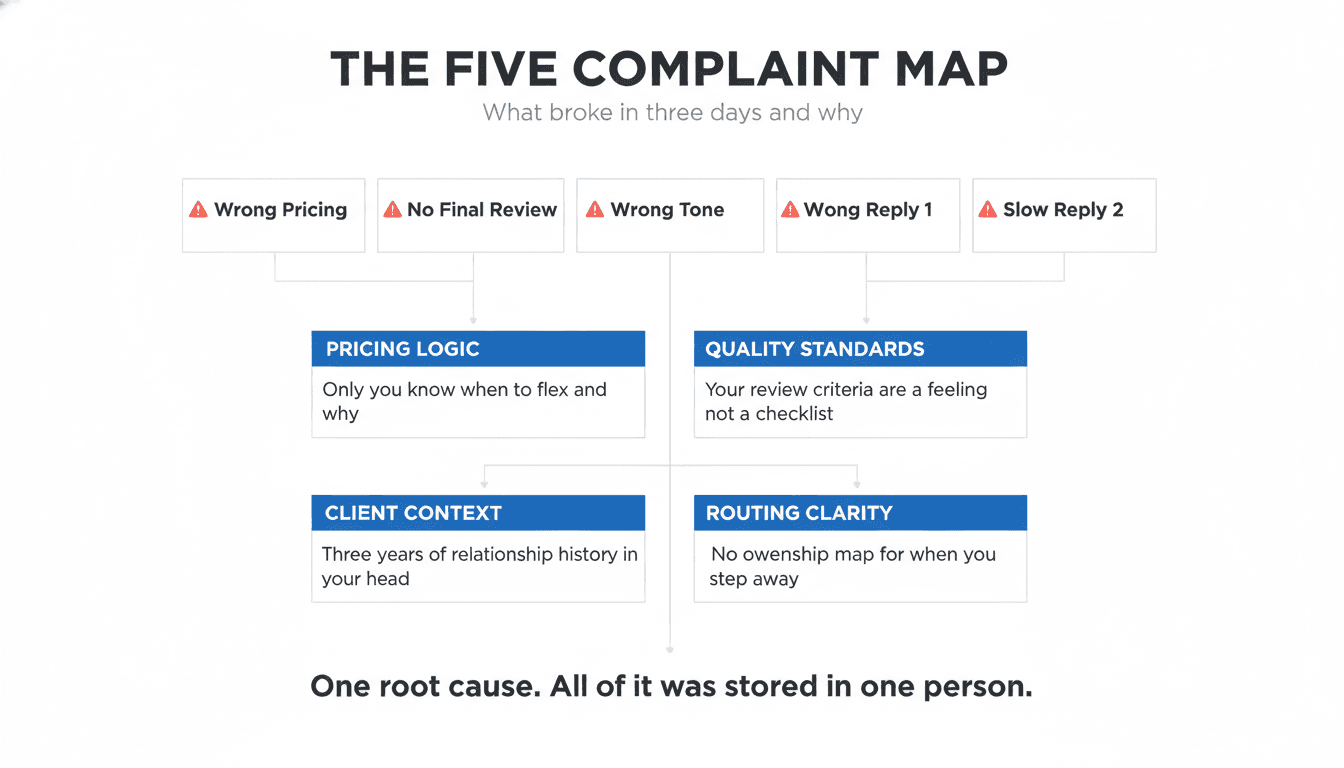
I came back on Monday morning to five client complaints. Not emergencies. Not catastrophic failures. Just five separate moments where the experience the client got was not the experience I would have delivered. A proposal went out with pricing that did not match the conversation I had with the prospect. A deliverable shipped without the final review pass I always do before it goes live. A client emailed with a concern and got a response that was technically correct but missed the tone entirely. Two others got slower replies than usual because nobody was sure who was supposed to handle their requests while I was gone.
Five complaints. Three days.
And the worst part? None of it was my team's fault.
The Pattern Nobody Talks About
Here is what most founders do after a weekend like that. They come back, clean up the mess, quietly absorb the lesson, and stop taking days off. Or they take fewer. Or they check their phone every two hours even when they are supposed to be away.
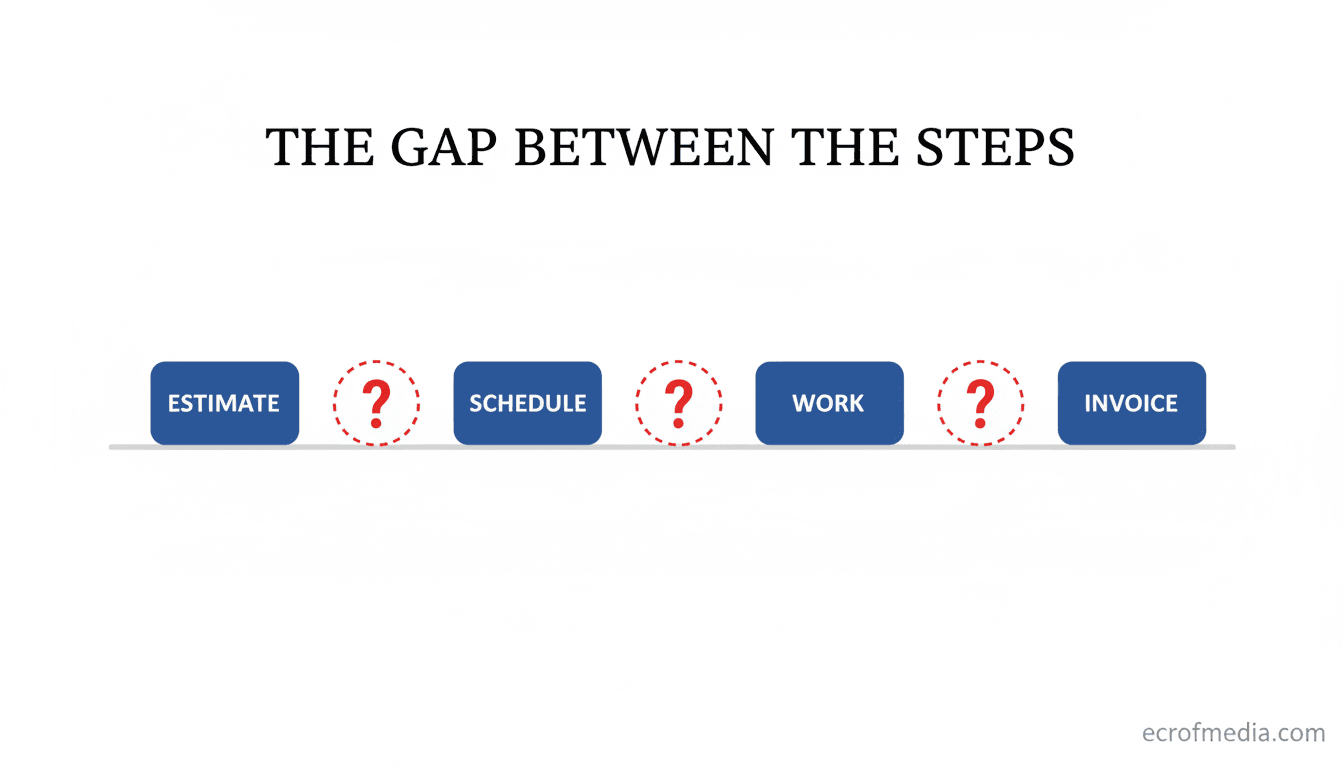
That is the pattern. Not a failure of the team. A failure of the business to operate without one person in the room.
And it does not just show up when you take time off. It shows up in the small moments every day. The team pausing before they send a proposal because they are not sure about the pricing. The account manager hedging on a client response because they do not know how you would have said it. The project lead routing a decision up to you that they could have made themselves, if they had the criteria.
Every one of those moments has a cost. Not just in time. In deals that move slower, clients who feel the inconsistency, and team members who start to doubt whether they are trusted.
What Actually Broke
When I looked at those five complaints, they mapped to five different categories of knowledge that were locked inside my head.
Pricing logic
The proposal that went out at the wrong number happened because the person who built it did not know the context. The prospect had mentioned budget constraints in a previous call. I knew we could flex on the rate for this one because the long term value was there. But that reasoning was nowhere anyone could access it. So they used the standard rate card and the prospect felt ignored.
Quality standards
The deliverable that shipped without my review was not bad. It was 85% of what I would have sent. But that last 15% is the difference the client notices. The things I catch are not random. They are patterns I have built over years of doing this work. My team does not see them yet because I have never made those patterns visible.
Communication tone
The email that was technically correct but missed the tone was a perfect example of intelligence that does not live anywhere except my instincts. That client is sensitive about timelines. I know that from three years of working with them. My team member did not know it because it was never captured. It just lived in the way I handled the relationship.
Routing clarity
The two clients who got slower responses fell through the cracks because there was no clear ownership map for when I am out. People assumed someone else was covering it. Nobody checked. Not because they did not care. Because the routing was never defined.
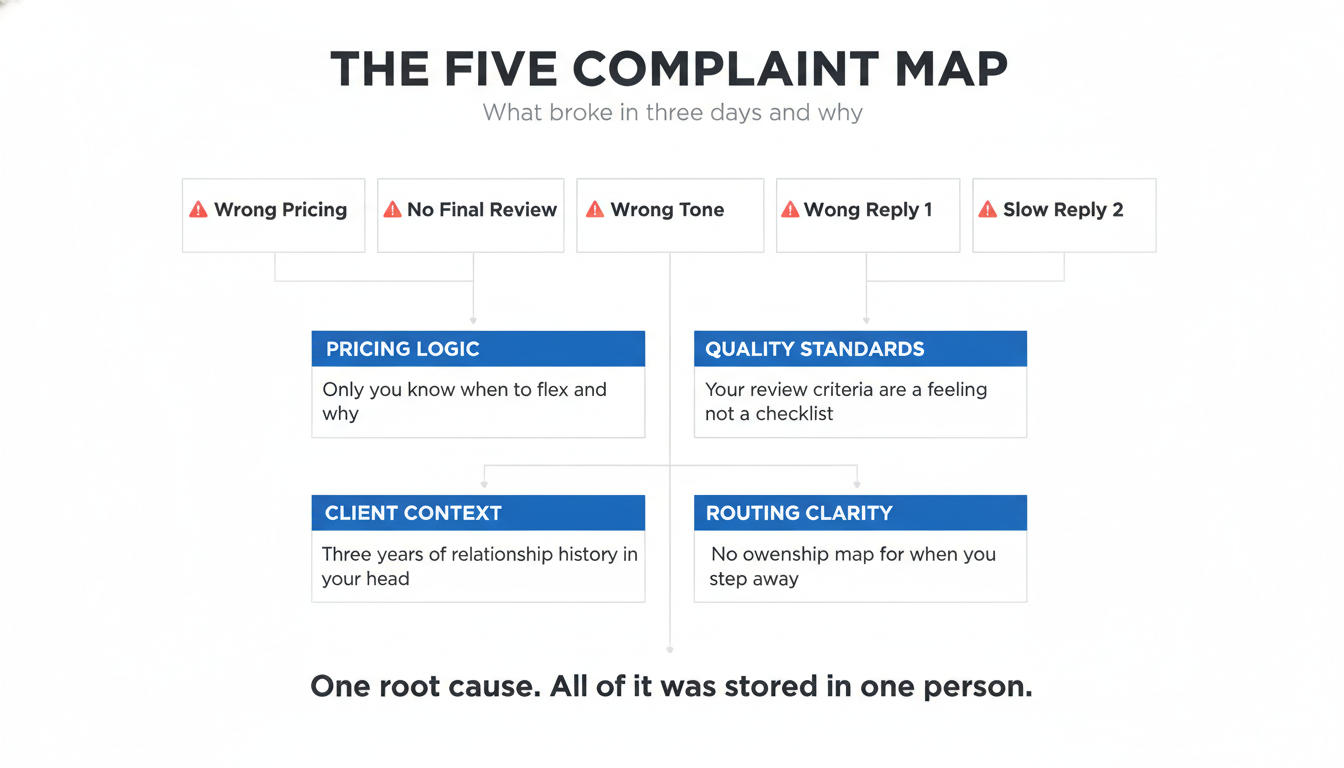
Five complaints. Four categories. One root cause. The business could not access what it needed to operate because all of it was stored in one place.
This Is Not a Delegation Problem
Most advice for this situation sounds like: build better SOPs. Train your team harder. Delegate more.
But delegation assumes the knowledge is transferable in its current form. It is not. You cannot delegate what has never been extracted. You cannot train someone on standards you have never articulated. You cannot hand off client relationships when the context that makes those relationships work is invisible.
The problem is not that your team needs more training. The problem is that the business intelligence they need to perform, the pricing logic, the quality patterns, the client context, the decision criteria, was never made accessible to anyone other than you.
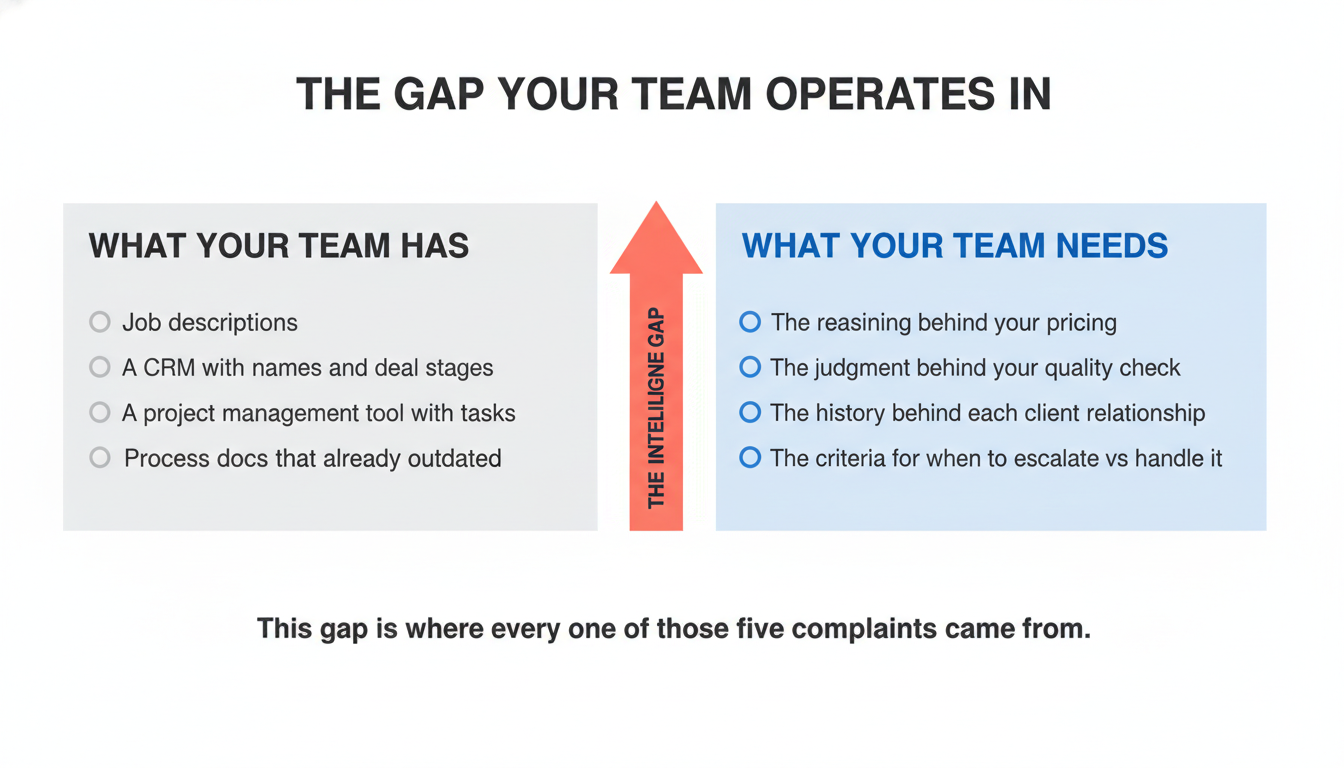
Think about what your team actually has access to when you are not in the room. They have job descriptions. Maybe a few process documents that are already outdated. A CRM with names and deal stages. A project management tool with tasks.
What they do not have is the reasoning behind the pricing. The judgment behind the quality check. The history behind the client relationship. The criteria for when to escalate and when to handle it themselves.
That gap between what they have and what they need is where every one of those five complaints came from.
The Real Cost of Three Days
Five complaints sounds manageable. You clean them up in a morning. But the real cost is not the cleanup.
It is the compound effect. Every time your business produces an inconsistent experience because you were not there to intervene, trust erodes. Clients start to notice. They do not always say it directly. They just start paying closer attention. They ask more questions. They request more updates. They copy you on emails they used to send to your team.
And internally, your team absorbs a different lesson. They learn that stepping up while the founder is away leads to problems. So they stop trying. They wait. They check with you first. They hold decisions until you are back. And suddenly your calendar is full of approvals that should not need you.
One founder I worked with tracked this over a quarter. Every time he was unreachable for more than 24 hours, his team accumulated an average of 14 pending decisions that waited for his return. Fourteen decisions, sitting idle, creating downstream delays across projects, proposals, and client communication. Over a quarter, that was more than 160 stalled decisions. At an average resolution time of 20 minutes each, that is 53 hours of decision backlog. Per quarter.
That is not a time management problem. That is a structural problem. The business does not know what the founder knows. So it waits.
What Needs to Exist So This Does Not Happen Again
The fix is not taking fewer days off. The fix is making what you know accessible to the business.
Start with the categories that caused the most damage last time you stepped away. For most founders, that is pricing logic and quality standards. Those two alone account for the majority of inconsistencies that clients notice.
For pricing
Look at your last 15 to 20 deals. Walk through the reasoning behind each one. Where did you flex? Where did you hold firm? What made you decide? You will find patterns. Maybe three to five decision rules that cover 80% of your pricing calls. Write those down. Give them to your team. Let them use the criteria for two weeks without asking you.
For quality
Pull five recent deliverables that you revised before they went to the client. Mark every change you made. Next to each one, write one sentence about why. Not the correction. The principle. Was it a tone issue? A structural problem? A missing detail the client cares about? Those principles become your quality checklist. Not a gate that requires your approval. A standard your team can apply on their own.
For client context
Pick your top ten active clients. For each one, capture three things: what they care most about, what triggers concern, and what keeps them loyal. This is the intelligence your team needs when they interact with those clients without you in the room.
For routing
Define who owns what when you are away. Not general ownership. Specific scenarios. Who handles pricing questions? Who responds to client concerns? At what threshold does something need to wait for your return versus getting handled now?
None of this requires a six month project. It requires focused extraction. Thirty minutes a day for two to three weeks can cover the highest priority categories. And each one you complete gives the business more capacity to operate without everything routing through you.
Three Days Should Not Cost You Five Relationships
The point of packaging what you know is not so you can take more vacations. It is so the business delivers the same quality, the same judgment, the same experience whether you are in the room or not.
Because right now, every time you step away, the business reveals what it cannot do without you. And your clients are the ones who feel it.
Three days should not cost you five relationships. If it does, the answer is not to stop stepping away. The answer is to make what you know accessible from anywhere.
Sources and References
Join Us Live
If this sounds familiar, we run a live workshop where we walk through exactly where your business intelligence is accessible and where it is still trapped. You will leave with a clear picture of what needs to be packaged first.
See this in your own business.
We run a live workshop where we walk through exactly where your business intelligence is accessible and where it is still trapped. You will leave with a clear picture of what needs to be packaged first.
Join the Live Workshop