Nothing in Your Workflow Is Broken. The Gaps Between the Steps Are.
Every step in your process has an owner. The space between two steps has nobody, and that is where your week is going.
The work was finished on Tuesday. The invoice went out the following Monday.
Five days. And nobody was slow.
Whoever did the job wrapped clean and sent the photos that same afternoon. Whoever handles the billing was at the desk all week. Nothing was waiting on a decision. Nothing was waiting on the customer. Every person did their part correctly and on time. Including you.
So where did the five days go?
Not into a step. Every step was fine. They went into the space between two steps, where nobody was standing.
Every step has a name on it. The space between has nobody.
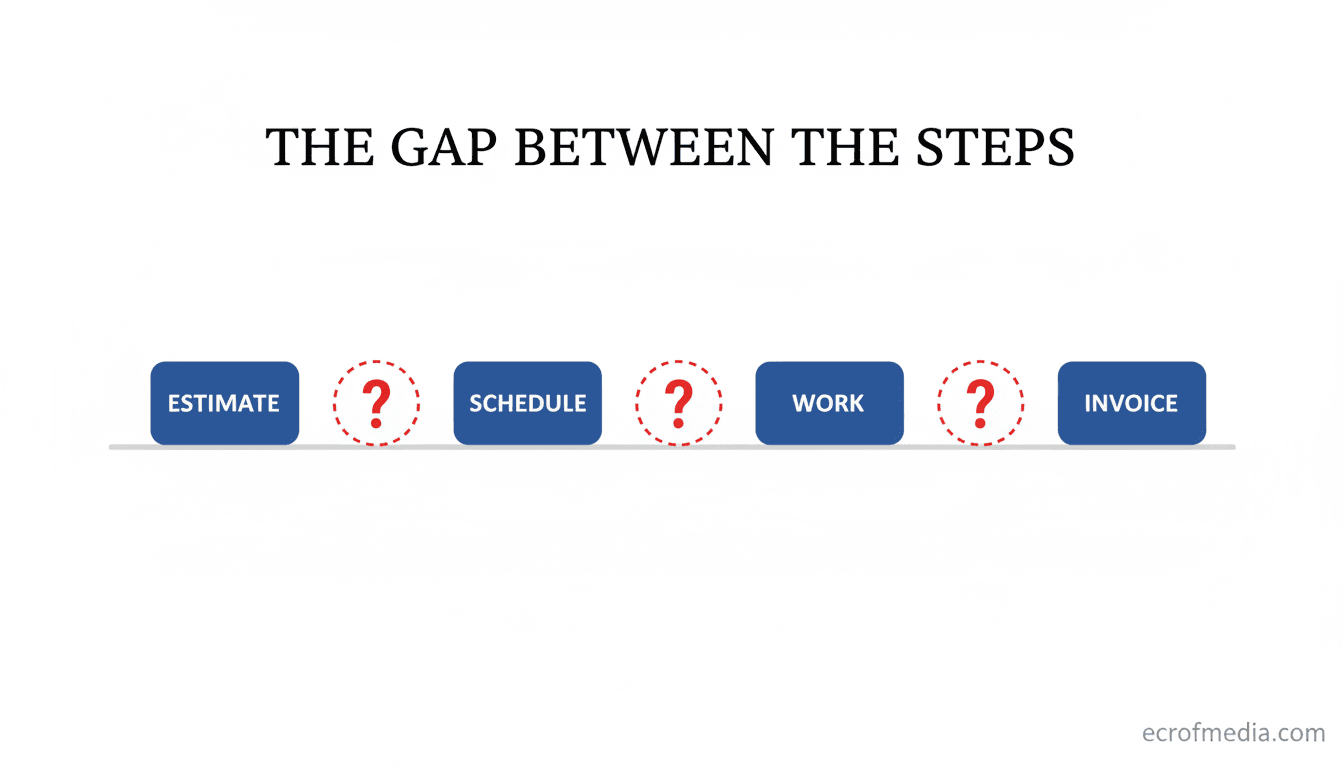
Try it right now on paper. Write out how a job actually moves through your business. First contact to money in the bank.
You will find a name for every line. Even if the name is yours. Estimate. Schedule. Do the work. Invoice. Follow up.
Clean list. Everybody accounted for.
Now look at what sits between the lines.
Who owns the moment an estimate becomes a scheduled job?
Who owns the moment the work is finished and billing needs to know?
Who owns the moment somebody says yes on the phone and that yes has to become a real thing on a real calendar?
Nobody does.
Those are gaps. And a gap never looks like a problem, because it has no name, no owner, and no box on any chart. It only shows up later. As a delay somebody has to apologize for.
You do not have a people problem. You have a handoff problem wearing a people costume.
Which is why hiring rarely fixes it. Add a good person to a process full of gaps and you get a good person standing exactly where everyone else was standing, watching the work sit in the same unowned space. Six months later the delays are back, and the story becomes that the hire was not the right fit.
The hire was fine. The gap was never closed.
The move
Before you add anyone, draw the path a job takes and mark every place it changes hands. You are not looking for bad steps. You are looking for the spaces between good ones.
Why do handoffs fail when everyone is doing their job?
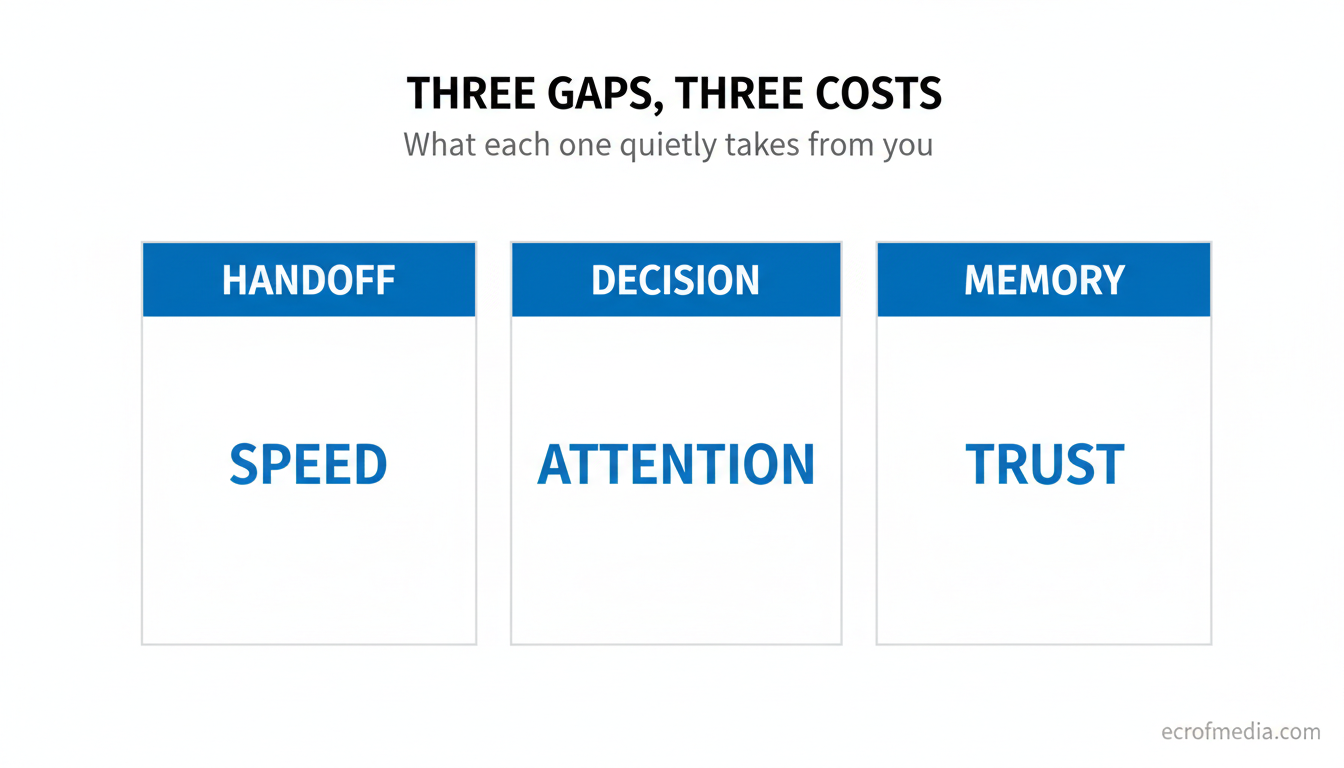
Because gaps are not all the same, and they do not cost you the same thing. Three of them show up in almost every business we look at.
The handoff gap
Work gets finished by one person and has to become live for another. Nothing carries it across. It waits for somebody to notice. And noticing was never anybody's job.
This one costs you speed. It is the five days on the invoice. The quote that goes out Thursday instead of Monday. The customer who called two competitors while your paperwork sat in the space between two capable people.
The decision gap
Work reaches a point where a call has to be made, and whoever is holding it does not have the authority or the reasoning to make it. So it stops. And waits for you.
This one costs you attention. It is why your phone is the load bearing wall of the entire operation. Not because nobody can decide. Because nobody was ever told what they are allowed to decide, or on what basis.
The memory gap
The information needed to move forward exists. It just lives inside a head, a text thread, or the front seat of a truck. So the next person rebuilds it, guesses, or calls the customer to ask something the customer already answered.
This one costs you trust. The customer does not see an internal handoff problem. They see a company that does not remember them.
Take the last thing that went sideways in your business. Not the worst thing. The last thing. You can almost always name which of the three it was.
And it is almost never somebody failing at their actual job.
The move
Sort your last three misses into speed, attention, or trust. Whichever bucket fills up first is the gap to close first. Not the loudest one. The fullest one.
The industry that was forced to solve this first
There is one field where a dropped handoff does not mean a late invoice.
Patient care moves through shift changes, unit transfers, and referrals constantly. Every one of those is a pass. When hospital systems went looking for where serious preventable harm actually started, communication failures kept surfacing. And a striking share of them clustered at exactly those transfer points.
Not during the treatment. During the pass.
So what did they do about it? They did not go hire better clinicians. They did not write longer manuals.
They made the handoff itself a defined event. The person handing off states the situation, the background, the assessment, and the recommendation. The person receiving reads it back. The pass is not complete because one person finished talking.
A handoff is not finished when someone lets go. It is finished when someone else has hold of it.
Your business has the same transfer points. Sales to scheduling. Field to office. Office to billing. Billing to follow up.
And if you work alone, you still have all of them. They just happen between two versions of your own attention, on two different days. The version of you on Monday is not always briefed by the version of you on Friday.
The move
Pick your highest volume handoff and add a read back. One line from the receiver confirming they have it. That single sentence is the entire hospital protocol in the smallest form it comes in, and it costs nothing.
What does it actually take to close a gap?
Less than people expect. It is not a platform purchase and it is not a reorganization.
Every closed handoff has the same three parts.
- A named receiver. Not a department. One person, or a clearly defined role, responsible for the work crossing the line. Ownership that lands on a group lands on nobody.
- A definition of done. What has to be true before the work is allowed to move. Photos uploaded. Final measurements recorded. Signature captured. If done is a feeling, the pass keeps happening at the wrong time and keeps coming back.
- A visible state. Anyone who cares should be able to see where the work is without asking a human being. The moment the only way to know the status of something is to interrupt somebody, you have built a business that requires interruption to run.
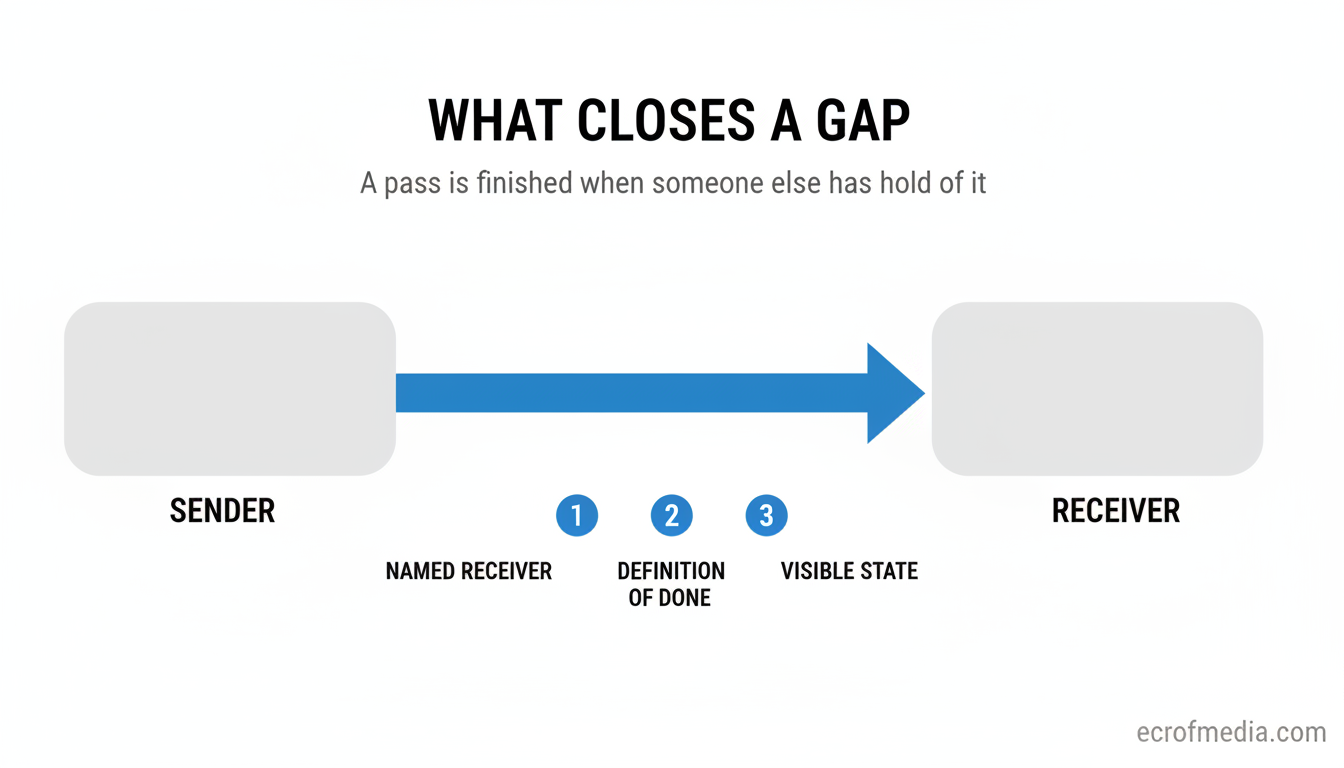
Notice that none of the three require software. They require a decision.
Software makes a closed handoff faster and harder to skip. It cannot invent an owner where you never named one. Point it at a gap and it will hand you back a faster gap.
The move
Take one handoff and write the three parts on an index card. Receiver. Done. Where anyone can see it. If you cannot fill all three in under two minutes, you just found today's problem.
Draw your gap map this week
Do this by hand before you do it any other way. Twenty minutes. Nobody's permission required.
One page. Down the middle, draw the real path a job travels, from first contact to paid. Not the ideal path. The one that actually happens. Most service businesses land somewhere between five and nine boxes.
Between every two boxes, draw a small circle. Each circle is a handoff.
In every circle, write one name.
Not whoever finished the step before. Not whoever starts the step after. The one accountable for the crossing itself.
Any circle you cannot fill in a second or two, mark in red.
For each red circle, write down three things. What tells the receiver it is their turn. What has to be true before the work can move. Where anyone can see it sitting there waiting.
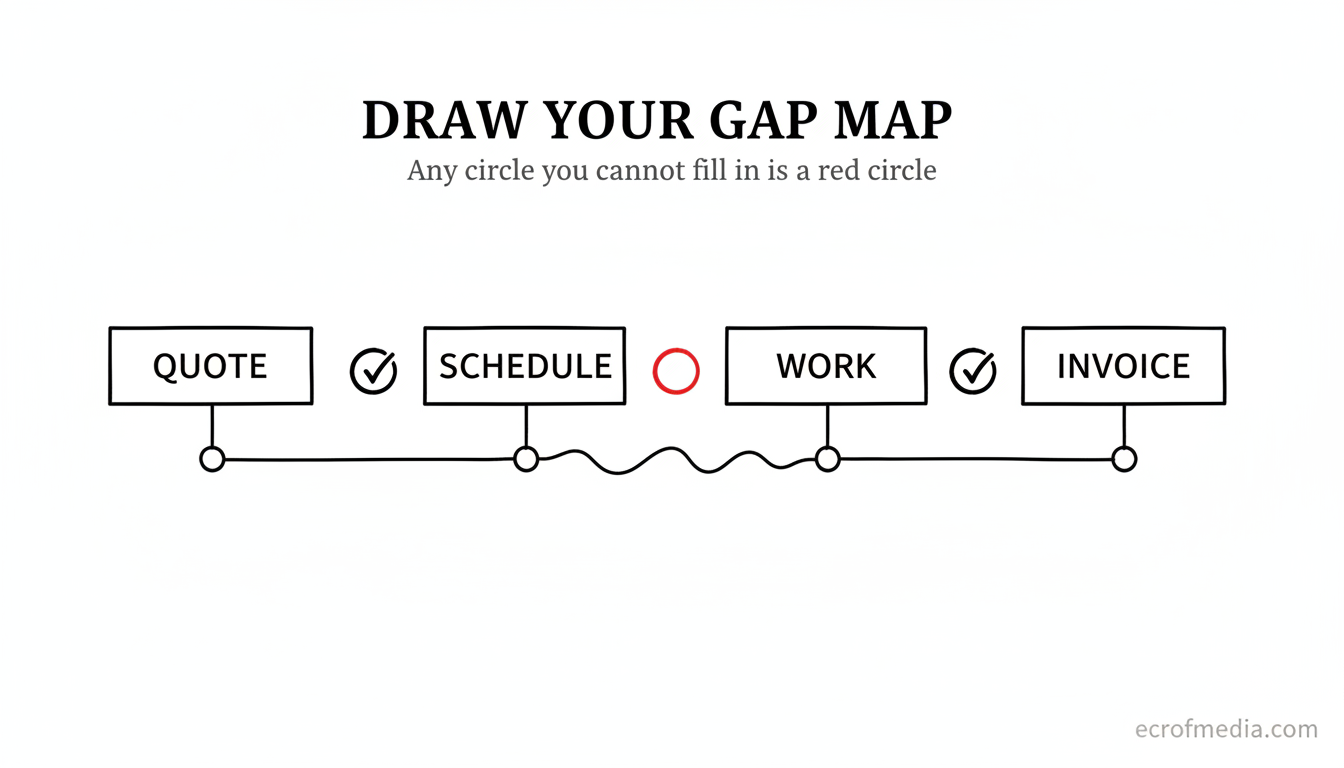
Almost nobody fills in every circle on the first pass. That is not the exercise failing. That is the finding.
The red circles are where your week is going. They have been there long enough that everyone stopped seeing them and started working around them instead.
Working around a gap looks a lot like being busy.
Start with one
Pick the red circle that shows up most in customer complaints, or in your own evenings. Close only that one. Give it two weeks before you touch a second. A business that closes one gap properly every month is unrecognizable in a year.
The four minute version
Not sure which gap is costing you the most?
The Executive Tax Assessment asks twelve questions across Marketing, Sales, Operations, and Customer Service, then hands back a briefing showing which parts of the business still route through you and where the work is waiting on a person instead of a process. Most owners spot their worst red circle before they finish the questions.
Find My Red CirclesThe gap is where the money is
Most improvement energy goes into the steps. Better people. Better scripts. Better tools for whoever is doing the work.
All of it helps. All of it hits the same ceiling.
Because a business is not the sum of its steps. It is the sum of its steps plus the quality of the passes between them.
You can have every station running well and still have a business that moves slowly, still needs you in the middle of it, and still leaks margin in a way nobody can quite point at. That is not a talent problem. It is not a discipline problem. It is unowned space.
Which is the good news, honestly. Unowned space is cheap to close and it compounds. Nobody has to work harder. Nobody has to be replaced.
Somebody just has to be standing where nobody was standing.
Start here
See where your business is waiting on you.
You can spend a Saturday drawing the map by hand, and it is worth doing. If you want the shape of it before then, the Executive Tax Assessment takes about four minutes and comes back with a briefing on where the work stops moving without you in the room.
Calculate Your Executive TaxWhere this comes from
- The Joint Commission: Sentinel Event Alerts on inadequate hand off communication
- Harvard Business Review: Collaborative Overload, on the rising cost of coordination work
- Asana: Anatomy of Work, on time lost to work about work
- Gallup: employee engagement research, including whether people know what is expected of them at work
Find your red circles in four minutes.
The Executive Tax Assessment is twelve questions across Marketing, Sales, Operations, and Customer Service. It comes back with a briefing showing which parts of the business still route through you and where work is waiting on a person instead of a process.
Calculate Your Executive Tax