
The Real Cost of Being the Answer to Everything in Your Business
When every decision, approval, and question routes through you, the cost is not just your time. It is the compound drag on your team, your deals, and your margin. Here is how to see it and what to build instead.
You built this business. You know every client, every margin line, every exception to every rule. When something needs a decision, it comes to you. When something breaks, it comes to you. When something is unclear, it comes to you.
You are the answer to everything.
And that is the most expensive thing happening in your business right now.
Not your payroll. Not your software stack. Not your office lease. You. Sitting at the center of every decision, every approval, every question that your team does not feel empowered to answer on their own.
This article is about the real financial cost of that pattern, why it compounds faster than most founders realize, and what to build instead.
The Pattern Nobody Talks About
Here is what it looks like from the outside. The business is growing. Revenue is climbing. The team is expanding. Clients are renewing.
Here is what it feels like from the inside:
Your calendar is full but nothing strategic gets done.
Your team is capable but still waits on you for answers.
Deals lose momentum because approvals stall in your inbox.
You work longer hours at $3M than you did at $1M.
Every vacation creates a backlog that takes weeks to clear.
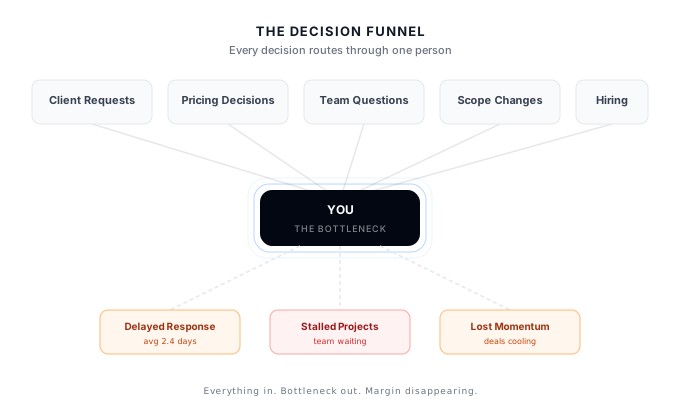
This is not a discipline problem. This is not a delegation problem. This is an architecture problem.
Your business was designed to flow through you. And now it cannot move without you.
What Decision Cost Actually Looks Like
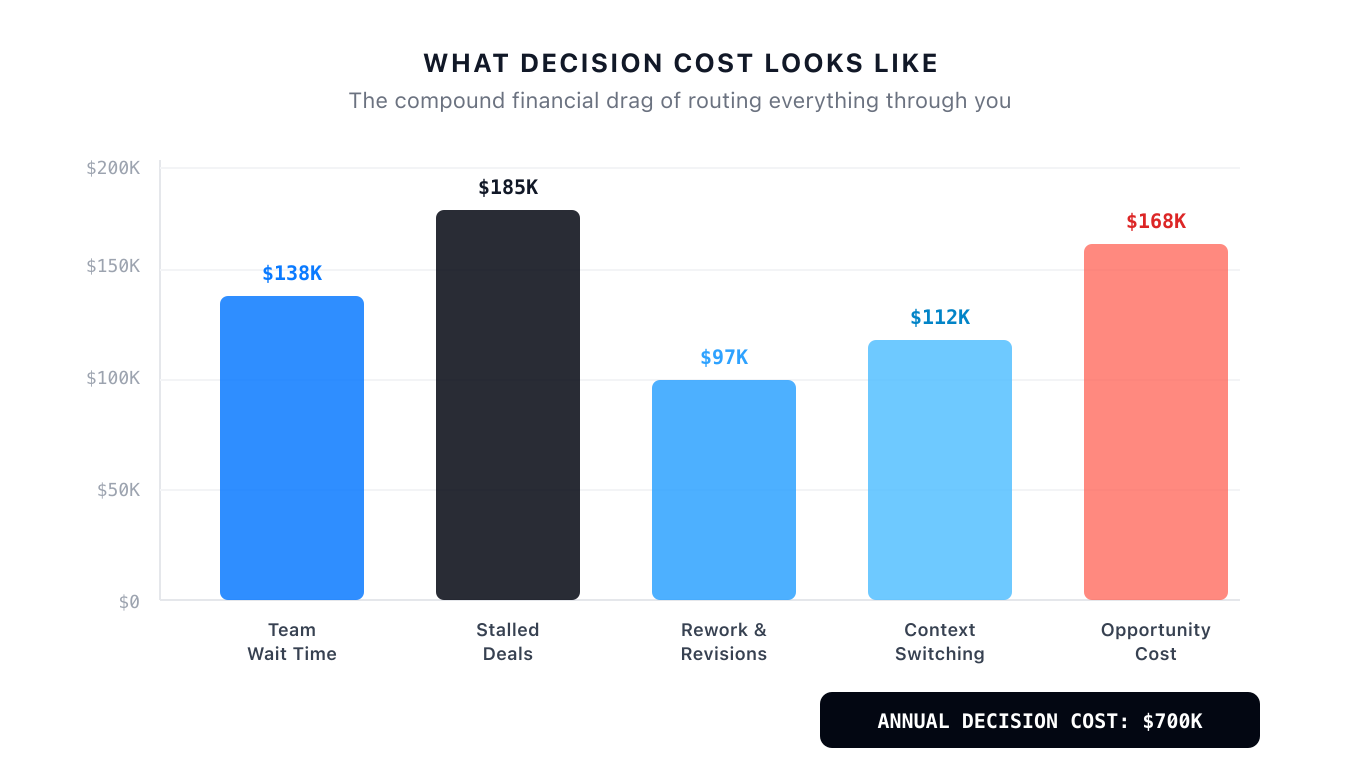
We call this Decision Cost. It is the total financial drag created when decisions, approvals, and questions route through a single point instead of flowing through a designed system.
Most founders think Decision Cost is just their time. It is not. It is the compound effect of five forces working against your margin simultaneously.
1. Team Wait Time
Every hour your team spends waiting for your answer is an hour of paid labor producing nothing. In a business with 8 to 15 employees, this adds up fast. If three team members lose an average of 45 minutes per day waiting on you, that is over $130K in annual labor cost with zero output attached to it.
2. Stalled Revenue
Deals do not wait. Prospects cool. Proposals expire. Partnerships lose urgency. When pricing decisions, scope approvals, or contract terms need your sign off and you are in back to back calls, revenue stalls. Not because demand dropped. Because the decision did not move fast enough.
3. Rework and Revisions
When your team cannot get clarity in the moment, they guess. They make assumptions. They move forward with incomplete information. Then you review it and send it back. That rework cycle is expensive, not just in hours but in morale. People stop taking initiative when their work gets redone.
4. Context Switching
You are not making one decision at a time. You are making dozens. Pricing at 9am. A client issue at 9:15. A hiring question at 9:30. Scope approval at 9:45. Each switch costs cognitive load. Research shows it takes an average of 23 minutes to fully refocus after a context switch. Multiply that across a day of decisions and you have lost hours of your most valuable thinking time.
5. Opportunity Cost
This is the big one. Every hour you spend answering operational questions is an hour you are not spending on the work only you can do. Strategy. Relationships. Product direction. Market positioning. The work that compounds over years. That work does not get replaced. It simply does not happen.
Why Hiring Does Not Fix This
The instinct is to hire. Get a COO. Bring in a project manager. Add team leads.
And sometimes that is the right move. But not before the architecture is in place.
Hiring into a broken system does not fix the system. It adds more people to the bottleneck.
Here is what happens when you hire without decision architecture:
- The new hire asks you how to handle situations because no system tells them
- They learn through trial and error what you would approve
- They develop their own interpretation of your standards
- Inconsistency grows across the team
- You end up reviewing more, not less
The issue is not headcount. The issue is that no one knows what decisions they own, what the boundaries are, or when to escalate. That information lives in your head. And no job description transfers it.
The Five Symptoms
Most founders do not see the architecture problem because it shows up as other things. Here are the five most common symptoms:
Your team keeps asking for permission
Not because they lack capability. Because no system tells them what they are authorized to decide. So they default to checking with you. Every time.
Nothing moves when you are unavailable
If your vacation creates a two week backlog, your business does not have an operating system. It has you. And you cannot be replicated by being more available.
You review everything
Proposals, deliverables, pricing, client communication. If it all crosses your desk before it goes out, you are not a CEO. You are quality control. And quality control should not require the most expensive person in the building.
Decisions get relitigated
The same question comes up every few weeks. The same scope discussion. The same pricing exception. No one remembers how it was handled last time because there is no system of record. Every decision is made from scratch.
You feel indispensable
This is the most dangerous symptom because it feels good. Being needed feels like value. But indispensable and scalable are opposites. If the business cannot operate without you in every conversation, it is not a business. It is a practice.
Self Assessment
Count how many decisions came to you yesterday that someone else could have made with the right authority and context. If the number is higher than five, Decision Cost is actively compounding in your business.
What to Build Instead
The answer is not to remove yourself from the business. It is to remove yourself from the decisions that do not require you.
That requires three things:
Decision Architecture
A clear map of every recurring decision in your business, who owns it, what the boundaries are, and when escalation is required. Not a philosophy. A system. Written, shared, and operational.
Authority Design
Explicit ownership by decision category. Not job titles. Not vague delegation. Specific authority: this person can approve scope changes up to this threshold, this person owns pricing within these parameters, this person handles client escalations using these criteria.
Operational Memory
A system that records how decisions were made so they do not need to be relitigated. When the same situation comes up again, the team has precedent. They have criteria. They have a decision that already exists instead of starting the conversation from zero.
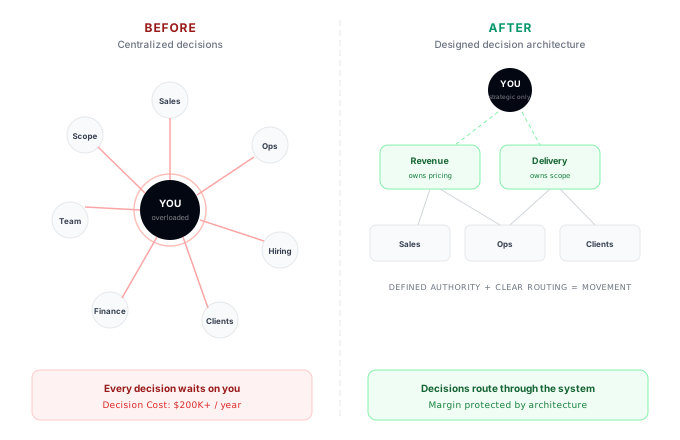
The goal is not to do less. The goal is to design a business that thinks without you in the room.
The Math That Changes Everything
Here is a simple calculation most founders have never done.
Take your annual revenue. Now estimate the percentage of your week spent on decisions someone else could make if they had the right system. Multiply your effective hourly rate by those hours. Add the wait time cost for every team member affected.
That number is your Replaceable Cost. The total value of time you spend on work the business should handle without you.
For most founder operators between $2M and $10M, Replaceable Cost lands between $200K and $500K annually.
That is not revenue you are losing. That is margin you are burning. Every single year.
And it compounds. Because every year you do not install the architecture, the pattern deepens. The team becomes more dependent. The decisions become more centralized. The cost grows.
This Is What the Live Workshop Addresses
The live workshop is designed specifically for founders who recognize this pattern. Not theory. Not coaching. A structured session to:
- Map where Decision Cost lives in your business
- Identify the decisions that should not require you
- Define the authority structure your team actually needs
- Walk away with a clear picture of what to build first
It is designed for operators who are ready to stop being the answer to everything and start building the system that answers for them.
Sources and References
Join Us Live
If you recognized your business in this article, the live workshop will show you exactly where the cost is hiding and what to design first. No theory. Just clarity.
See this in your own business.
We run a live workshop where we walk through exactly where your business intelligence is accessible and where it is still trapped. You will leave with a clear picture of what needs to be packaged first.
Join the Live Workshop