What Just Walked Out the Door
What looks like a productivity story is actually the largest exposure of unpackaged business intelligence in five years.
What looks like a productivity story is actually the largest exposure of unpackaged business intelligence in five years.
This month, U.S. companies cut more than 37,000 jobs in 10 days. Every press release explained it the same way. They were becoming more efficient. Pivoting to a new operating model. Rethinking the structure. Restructuring around the technology.
I read every one I could find. They all said the same thing. None of them said what was actually happening inside those buildings.
Here is what the press releases miss. The people walking out the door this week are not the slack in the system. They are the system. They are the people who knew which client called every Friday. Which vendor takes three followups before they respond. Why the Tuesday workflow exists. The reason a specific exception was added to a process in 2023, and the conditions that triggered it.
That knowledge does not exist in a document anywhere. It exists in a person.
When the person leaves, the knowledge leaves with them.
The Pattern
I have watched this from the other side. The companies cutting headcount this month are not making a productivity decision. They are making a cash decision. The productivity story is the press release. The cash story is the spreadsheet.
That distinction matters because the press releases tell you what the company believes about itself. They believe they were carrying excess capacity. They believe the new operating layer can absorb the work. They believe the people leaving were doing things that can be replicated by structured systems.
Sometimes that is true. Sometimes it is not.
The way to tell, before the cut, is to ask one question.
If this person walked out the door tomorrow, would the operation degrade? If yes, what specifically would degrade? If you can name three concrete things, that person was carrying institutional intelligence the company has not yet packaged.
Most companies cannot answer that question. They confused tribal knowledge for institutional capability. They looked at a team that ran smoothly and concluded the smoothness was structural. It was not. It was carried.
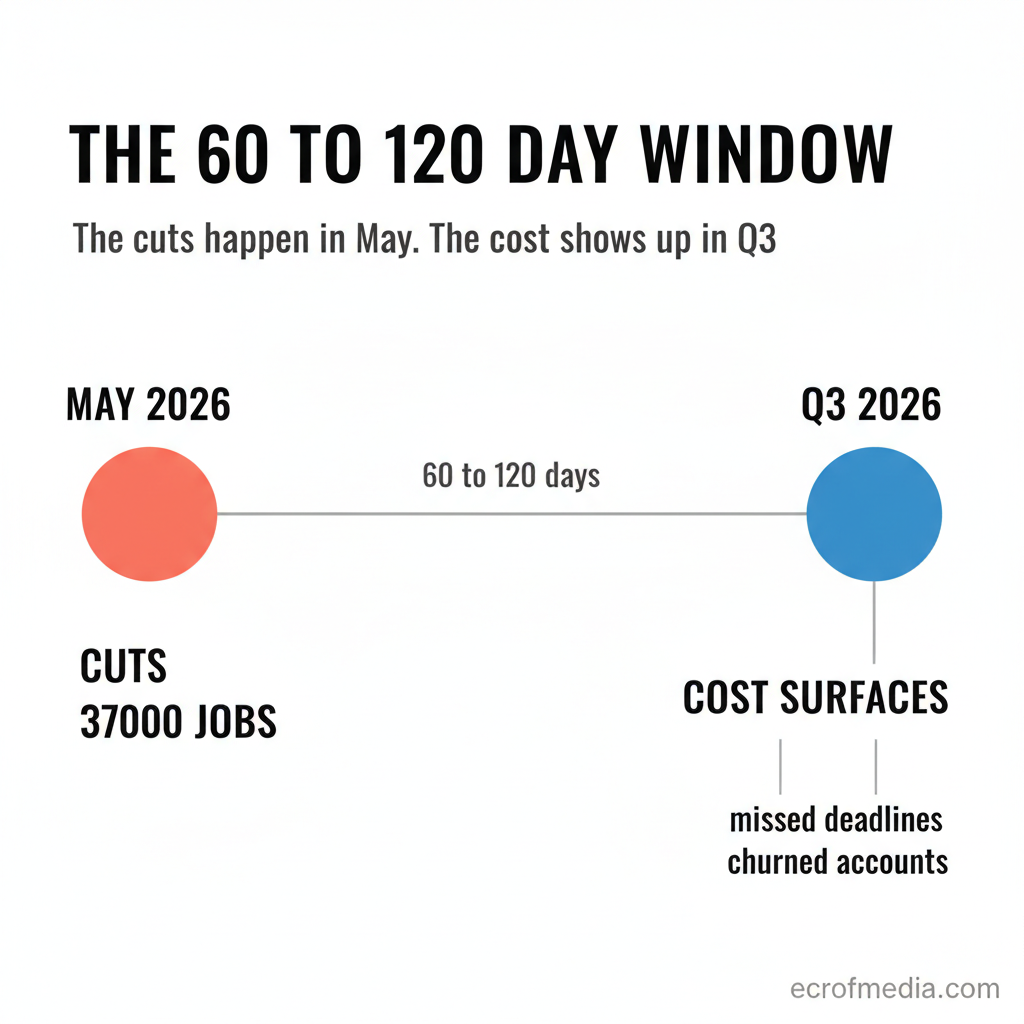
The 60 to 120 day window is when this shows up. You will not see it in May. You will see it in Q3 and Q4. The missed deadline that nobody catches. The customer who calls and gets a generic answer instead of the answer that fit their account. The new hire who used to ramp in 6 weeks and is now at 9 months because the people who would have answered their questions are gone.
The press release was also a confession. It was the company telling itself that the operational knowledge it just removed was already redundant. By the time the company learns it was not redundant, the people are no longer reachable.
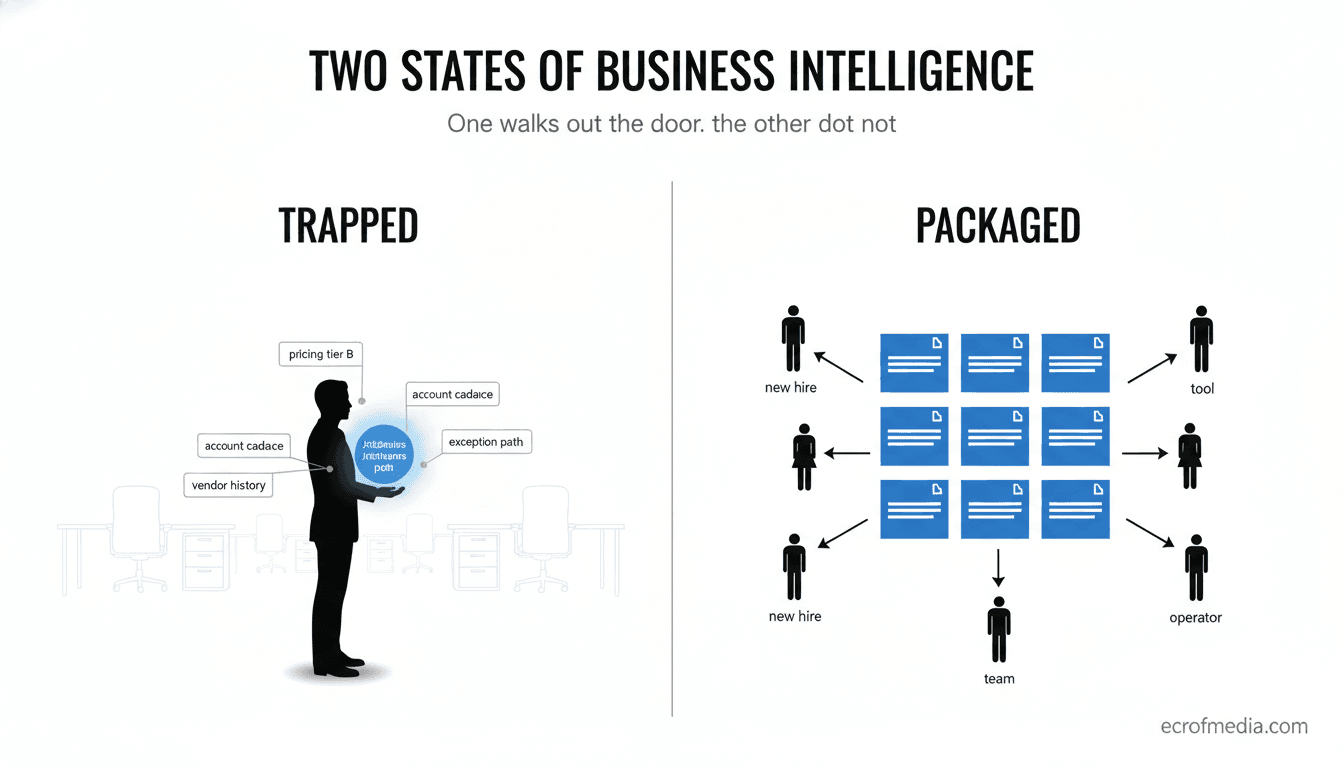
Two States Of Business Intelligence
Inside every business, intelligence exists in one of two states.
It is either trapped or packaged.
Trapped intelligence lives in a person. The founder who remembers why pricing tier B was created. The salesperson whose calendar contains the unwritten cadence of every key account. The operator whose email folder is the only place a critical vendor contract is documented. The technician who knows that for this specific category of failure, you skip step three.
Trapped intelligence has three properties. It is fast inside the head of the person who owns it. It is invisible to everyone else. And it disappears the moment the person disappears.
Packaged intelligence lives in structure. The pricing rule lives in a decision document any new salesperson can read. The account cadence lives in a queryable record any team member can pull. The vendor history lives in a system the operator does not control. The exception is captured as a rule, with the conditions that triggered it.
Packaged intelligence has three properties. It is slightly slower than the head of the person who used to own it. It is accessible to anyone who needs it. And it survives the person walking out the door.
Most companies have a mix. The mix is the problem.
The companies cutting this month are about to learn how much of their operation was trapped versus packaged. They are not going to be told. They are going to see it in the work. The deadline that slips. The customer who churns. The new hire who never quite picks up the thread.
And here is the part the press releases will never say.
The new operating layer they are pivoting to cannot replace trapped intelligence. It can only feed on packaged intelligence. If the knowledge was never structured, the system that was supposed to absorb the work has nothing to absorb. It can guess. It can produce something that looks competent at the surface and falls apart on the third question.
You cannot replace what you never packaged. You can only amplify what you did.
What To Do About It
Three moves. None of them are theoretical. All of them are designed for a business owner who reads the news and realizes the question is not whether their company is next. The question is whether they would know what they were losing if it were.
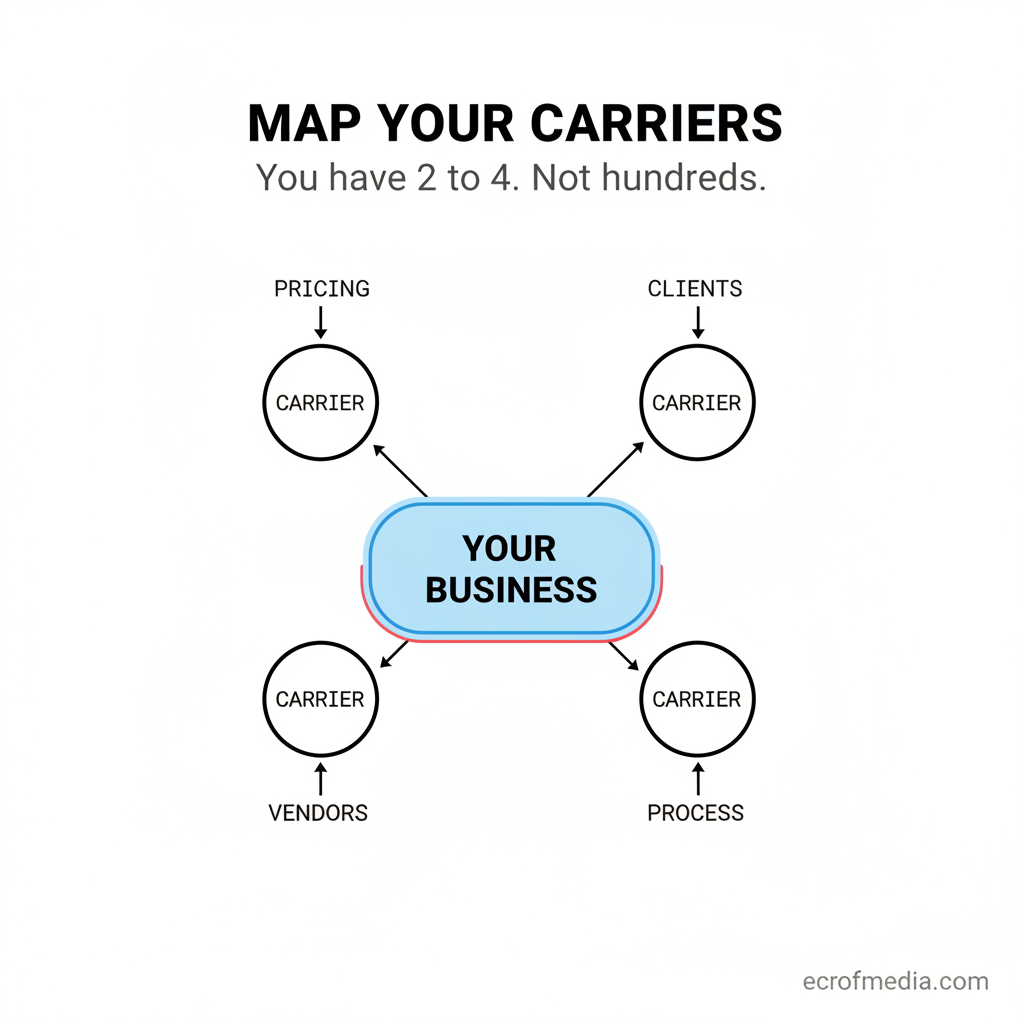
Move one. Map your carriers.
A carrier is anyone whose absence would degrade your operation in a specific, nameable way. You do not have hundreds. You have 2 to 4. Name them. Write the names down. For each name, write three concrete things that would break if they left next Tuesday.
This exercise will surface what you have not packaged. You are not looking for proof that your people are skilled. You are looking for proof that you do not depend on them to know things only they know.
Move two. Extract their patterns.
Patterns are not job descriptions. Job descriptions describe roles. Patterns describe decisions.
Sit with each carrier and ask three questions. What decision did you make this week that nobody else would have made the same way? Why did you make it that way? What conditions would change your answer next time?
Capture the decision, the reasoning, and the exception conditions. That is the extract.
Most companies skip this and write up the job description instead. The job description is the cover. The pattern is the substance.
Move three. Package the output.
This is the part most companies get wrong. They extract and then store the result in a folder nobody reads. That is not packaging. That is filing.
Packaging means the extracted intelligence becomes queryable. Any team member, any tool, any new hire can ask a question and get the carrier answer back, without needing the carrier in the room. That is the test. If the answer requires the carrier to be in the room, it is still trapped.
Structured documents in a known location. Decision records with conditions and exceptions. A system that any operator or any tool can read. That is package. The format matters less than the property: accessible from anywhere, by anyone, without permission.
The Real Question
The companies cutting now are answering the wrong question.
They are asking whether they can run with fewer people. They will find out in Q3.
The question they should be asking is whether they ever packaged what those people knew. If they did, the cuts will hold. If they did not, the cuts will come back as deadline misses, churned customers, and ramp times that triple.
The companies that packaged before they cut are quietly building the next operating model. The companies that confused trim for transformation are about to relearn an old lesson.
You can pay people to do the work. You can pay tools to do the work. But you cannot pay either to know what you never wrote down.
What just walked out the door, in 37,000 cases this month, was the institutional memory of dozens of companies. Some of them packaged it first. Most of them did not.
You can find out which one you are with one question.
If your two strongest operators walked out tomorrow, would the next quarter look the same?
If you are not sure, that is the answer.
That is also where to start. If you want to see what trapped looks like inside your own business, the Brain Map is the 45 minute diagnostic. Link in the footer.
Where the numbers come from
- American Bazaar Online: US layoffs first 10 days of May 2026 (38,000 jobs cut)
- Business Insider: The 2026 layoffs list (Meta, Amazon, Walmart, LinkedIn)
- Intellizence: Layoff Tracker 2026, weekly summary
- Cheapism: 2026 layoffs at major US companies, running list
- Politico Influence: Penta Group layoffs (37 staff cut)
See this in your own business.
We run a live workshop where we walk through exactly where your business intelligence is accessible and where it is still trapped. You will leave with a clear picture of what needs to be packaged first.
Join the Live Workshop